Why B2B SaaS Startups Are Replacing SDRs With AI in Their First 50 Employees
Pre-Series A SaaS founders are skipping the SDR hire and building AI-native outbound from day one. Here's the playbook, economics, and staged model replacing the traditional $1M ARR SDR hire.
Three years ago, the first-50-employees SaaS startup hired its first SDR around the $1M–$2M ARR mark. That was the playbook. That playbook is changing.
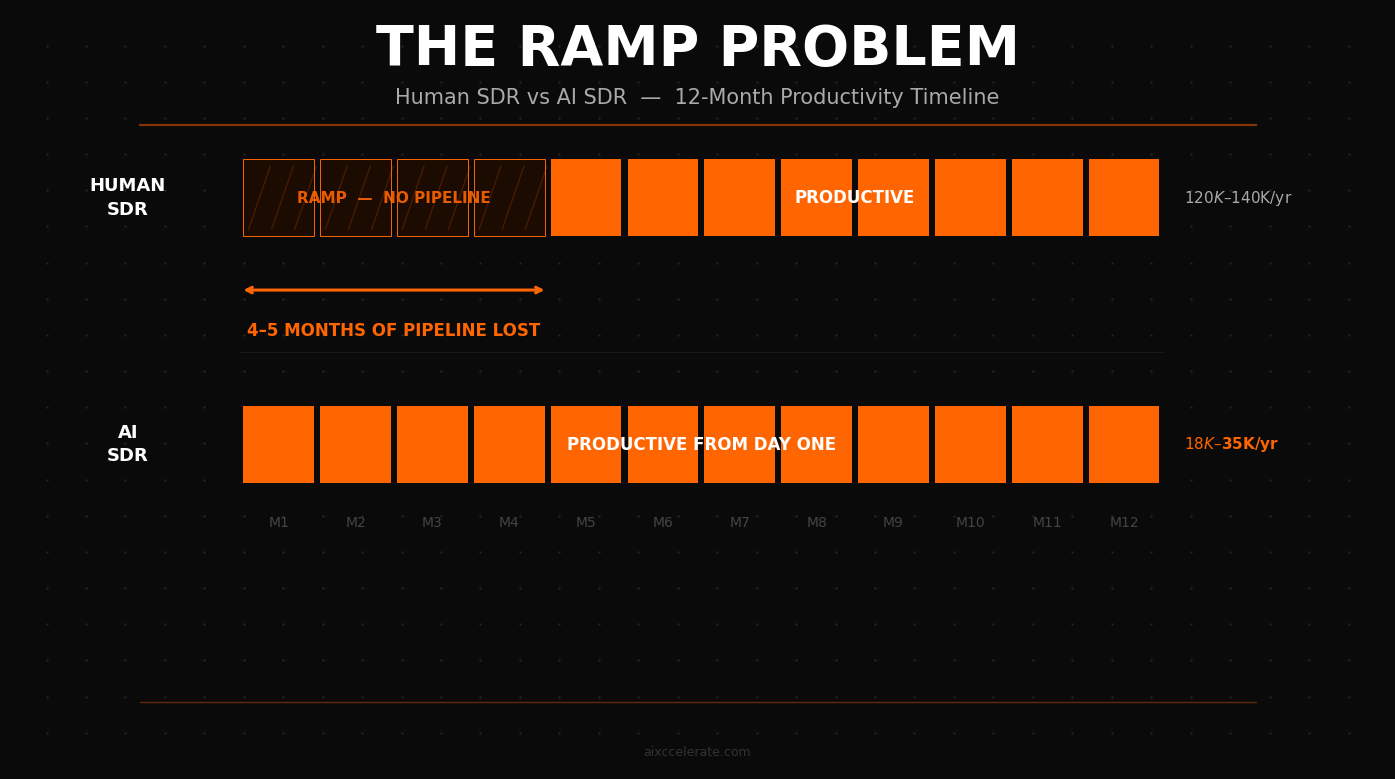
A growing number of SaaS founders are skipping the SDR hire entirely and building AI-native outbound from day one. Not because they're trying to be contrarian — because the economics are genuinely better. An AI SDR system costs $15,000–$35,000/year, is operational from day one, carries zero attrition risk, and often produces more qualified pipeline than a human SDR who spends 4 months ramping at a company in an uncertain stage.
The traditional "first SDR hire at $1M ARR" playbook was built for a world where outbound automation didn't exist at this level. That world is gone. Founders who recognise that fact earlier are arriving at Series A with better unit economics, more predictable pipeline, and a more compelling story for investors.
TL;DR
- The traditional "first SDR hire at $1M ARR" playbook costs $110,000–$140,000/year for a role that takes 4–5 months to reach productivity
- Pre-Series A SaaS companies burn 15–25% of their annual runway on a single SDR before seeing pipeline results — a significant capital efficiency drag
- AI SDR systems cost $15,000–$40,000/year, are operational from day one, and don't leave during fundraising crunch
- SaaS startups have a natural advantage for AI SDR adoption: defined ICP, specific use case, and buyers comfortable with digital-first outreach
- The founder-to-AI-SDR model is the lean growth pattern gaining traction in pre-Series A SaaS companies
- SaaS founders who skip the traditional SDR hire and build AI-native outbound are showing better capital efficiency metrics at Series A
Why the Traditional SDR Hire Is Particularly Expensive for Pre-Series A SaaS
At $1M–$3M ARR, a B2B SaaS company typically has $800K–$1.5M in cash runway and 8–15 people total. Every hire is a meaningful allocation of that runway.
Hiring an SDR means: a 4–5 month ramp before meaningful pipeline output, high attrition risk (SDRs at early-stage companies with uncertain futures face above-average uncertainty), no dedicated manager to onboard and coach them (the founder is the de facto manager, and the founder is simultaneously managing product, fundraising, and customer success), and $110,000–$140,000 in annual fully-loaded cost — 10–18% of annual runway — before the first meeting is booked.
In a capital-efficient market where Series A investors scrutinise burn multiple and revenue per employee, this is a difficult allocation to justify when an alternative exists.
The Emerging Model: Founder-to-AI-SDR
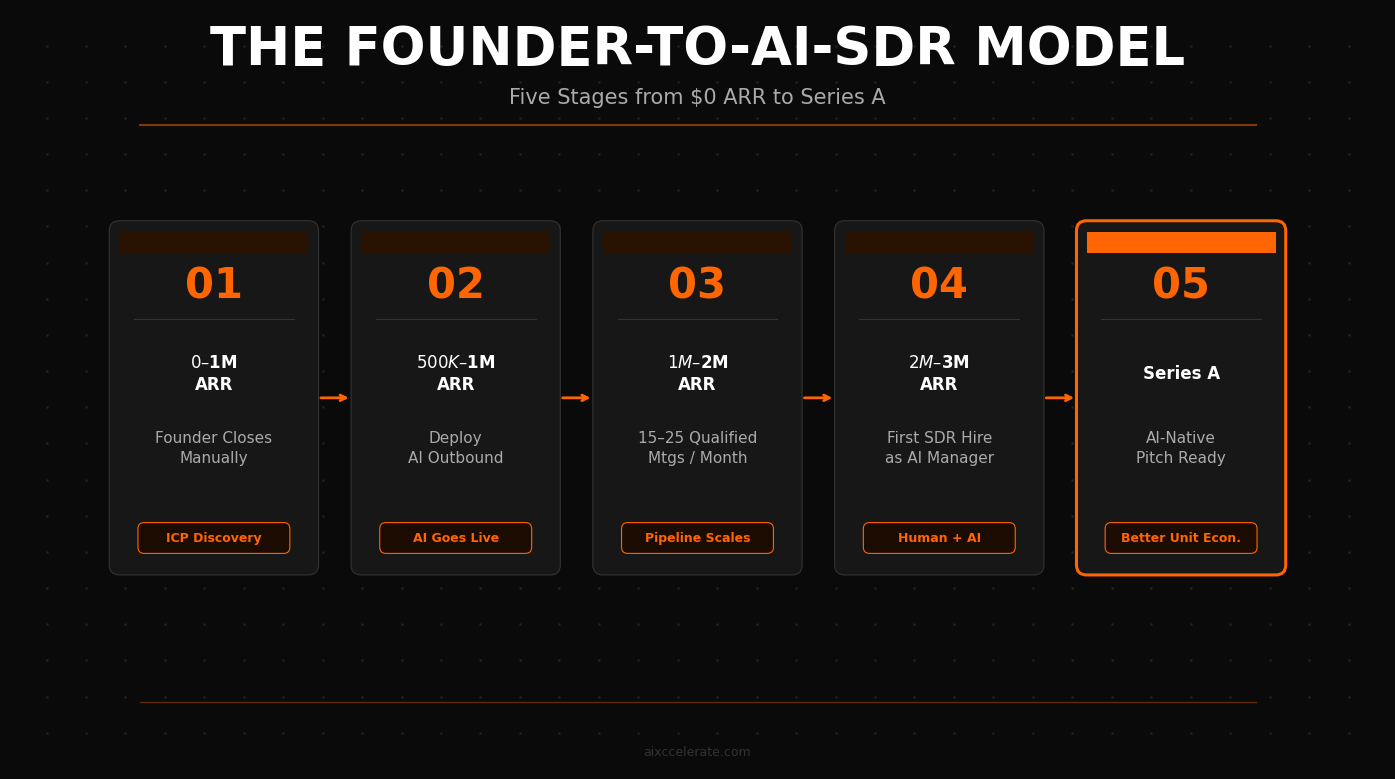
The model that's replacing the traditional SDR playbook at pre-Series A SaaS companies follows a predictable sequence.
Stage 1 ($0–$1M ARR): Founder closes first 20–30 customers personally. Deep learning about ICP — who buys, what triggers the purchase, what objections come up, what messaging converts.
Stage 2 ($500K–$1M ARR): Implement AI outbound targeting the exact ICP profile the founder has validated. AI handles prospecting, sequencing, and qualification. Founder handles qualified meetings.
Stage 3 ($1M–$2M ARR): AI is generating 15–25 qualified meetings per month. The founder's time shifts from 60% sales to 20% sales, with the AI doing the volume work. Product development and fundraising get more attention.
Stage 4 ($2M–$3M ARR): Hire first human SDR — not to generate pipeline manually, but to manage the AI system, handle warm inbounds, and take on the reply management work that benefits from human judgment.
Stage 5 (Series A): Present an AI-native revenue model with demonstrably better unit economics — lower CAC, lower burn multiple, better revenue per employee.
The Economics Comparison at Pre-Series A
| Approach | Year 1 Cost | Time to Productivity | Attrition Risk | Pipeline Output |
|---|---|---|---|---|
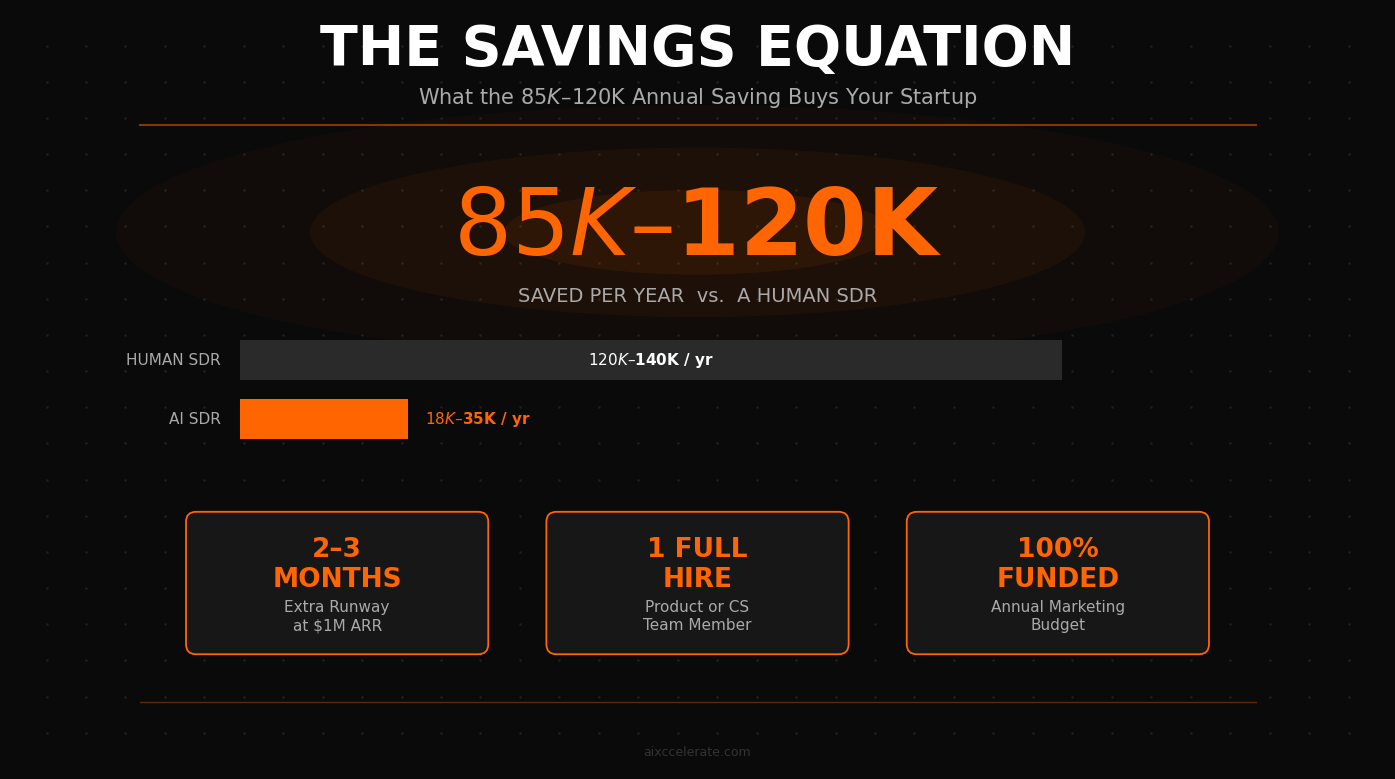
| Human SDR hire | $120,000–$140,000 | 4–5 months | High (35–45% annual) | 12–18 qualified meetings/month at quota |
| AI SDR system | $18,000–$35,000 | Day 1 — no ramp | Zero | 15–30+ qualified meetings/month |
| Savings / Difference | $85,000–$120,000/year | 4 months faster | Eliminated | Equal or better output |
The $85,000–$120,000 annual savings represents a meaningful extension of runway. At $1M ARR, that's 2–3 additional months of operational runway — or the equivalent of a product hire, a customer success hire, or a meaningful marketing budget.
What Does the AI SDR's Role Look Like in a Pre-Series A Company?
The AI SDR handles what a human SDR would do in the first 8 touches of an outbound sequence: prospect identification, personalised outreach, multi-touch follow-up, reply categorisation, objection handling, and meeting booking. The founder reviews the AI's activity weekly (30–60 minutes), takes the qualified meetings, and provides feedback to refine the targeting and messaging.
The founder's involvement doesn't go to zero — it concentrates on the highest-value moments (the discovery calls, the ICP refinement feedback) rather than the volume work (the 200 outreach contacts per week).
Illustrative Example: The SaaS Startup That Went from $0 to $2.4M ARR With No SDR Team
A B2B SaaS startup built their outbound AI-native from month 1. Two founders, no SDR hire.
The AI identified professional services firms with 10–50 employees that had recently hired a new operations leader, and executed 10-touch sequences across email and LinkedIn.
- Month 3: 6 meetings, 2 deals, $36K ARR
- Month 9: 18 meetings/month, 5 deals/month, $380K ARR
- Month 18: 28 meetings/month, 8 deals/month, $2.4M ARR
Headcount at $2.4M ARR: 2 founders + 1 part-time SDR + 2 engineers. Revenue per employee (revenue team): $1.2M — a standout efficiency number at Series A. CAC payback: 8 months. Burn multiple: 1.1x. The Series A was oversubscribed.
For the full economics comparison, read AI SDR Cost in 2026: A Real TCO Breakdown vs a Human SDR.
[LEAD MAGNET CTA] Want to model the AI SDR path for your SaaS startup? Use the free AI Revenue Team ROI Calculator.
How AI Xccelerate Works at the Pre-Series A Stage
Jules, AI Xccelerate's outbound AI agent, was built with the pre-Series A SaaS founder in mind. The typical setup: the founder defines the ICP and messaging based on their early customer learning, Jules handles prospecting, sequencing, and qualification, and the founder takes the qualified meetings. Total founder time commitment: 30–60 minutes per day.
This is a meaningfully different allocation than the typical pre-Series A outbound motion — which either consumes 3–4 hours of founder time per day or sits undone because the founder is busy with other things. The AI runs regardless of what else is demanding the founder's attention.
FAQ
When should a SaaS startup make its first SDR hire?
With an AI-native approach, the first human SDR hire can be delayed until $2M–$3M ARR without sacrificing pipeline generation. When made, it's a different role: managing and optimising the AI system, handling warm inbounds, and taking on reply management — not grinding through cold outreach manually at 200 contacts/day.
Does an AI SDR work for SaaS products with long sales cycles?
Yes, but the timeline to revenue impact is longer. For a 3-month sales cycle, expect first AI-generated closed revenue at month 5–6 from deployment (pipeline generation + cycle time). The AI's advantage compounds over time — by month 12, the pipeline it built months 1–6 is converting.
Can a founder realistically manage an AI SDR system alongside product and fundraising?
With the right configuration, yes. The daily management requirement for a well-tuned AI outbound system is 30–60 minutes — reviewing flagged replies, approving meeting bookings, and providing periodic ICP feedback. This is meaningfully less than the 3–4 hours of manual outbound it replaces.
What is the best ICP configuration for an AI SDR at an early-stage SaaS company?
Start ultra-narrow: the exact profile of your 5 best current customers, with specific trigger events. Early-stage AI SDR deployments that fail almost always do so because the ICP was too broad. Narrow first; expand as you validate.
How does an AI SDR handle technical objections about a SaaS product?
The AI handles pre-qualification objections (timing, budget, priority) in the written back-and-forth. Technical objections that arise in the discovery meeting phase are handled by the founder or AE in the live conversation — which is the appropriate point for those objections anyway.
Do investors see AI-native revenue models positively at Series A?
Increasingly yes. Capital efficiency metrics at Series A — revenue per employee, CAC, LTV:CAC, burn multiple — are scrutinised closely, and AI-native models show demonstrably better numbers. Investors who understand the model see it as a structural advantage, not a shortcut.
Ready to build an AI-native revenue model for your SaaS startup? Book a 20-minute AI Workforce Audit