What B2B Sales Looks Like at AI-Native Companies in 2026
A few hundred B2B companies built AI-native revenue teams from scratch, sizing humans only for judgment work. Here's what the team, economics, and compounding results actually look like inside.

A few hundred B2B companies built their revenue operations from scratch in the last 3 years with AI as a core component, not an add-on. They didn't bolt AI tools onto a legacy sales process — they designed the process around what AI does well, sized the human team for what AI can't do, and measured success by revenue per employee rather than headcount.
The results are different enough from traditional sales teams that they represent a genuinely new model. These aren't companies that use AI to do the same things faster. They're companies that do fundamentally different things: smaller human teams generating more revenue with more consistency than larger human-only teams.
This post describes what that model actually looks like from the inside — the team structure, the roles, the economics, and why the compounding effects get more pronounced over time.
TL;DR
- AI-native revenue teams start by mapping the sales process, identifying which steps require human judgment, and building AI for everything else
- The human roles in AI-native teams are smaller in number, more senior in profile, and more focused on relationship-intensive and judgment-intensive work
- Pipeline velocity is higher: shorter time from first contact to qualified meeting, less administrative drag, more consistent follow-up completion
- AI-native teams have no "ramp time" problem: the AI component is fully operational on day one, forever — adding capacity is instant
- The economics are fundamentally different: fixed-cost AI capability that scales without proportional cost increase, vs. variable-cost human headcount that requires linear spending
- Companies that built AI-native revenue teams in 2023–2024 are now showing compounding effects: consistent pipeline, lower cost of revenue, and resilience to talent market fluctuations
What Does "AI-Native" Actually Mean in Sales?
An AI-native revenue team is not a team that uses AI tools. Most sales teams use CRM, sequencers, intent data, and meeting notes AI. That's tool adoption, not architectural change.
An AI-native revenue team is designed with the explicit assumption that AI will handle all structured, high-volume, and rules-based work — and human talent is sized and scoped exclusively around the judgment-intensive work that AI cannot do.
The difference is design intent. A traditional team asks: "How many people do we need?" and adds AI tools to help those people. An AI-native team asks: "What work actually requires human judgment?" and hires humans only for that work.
What Does an AI-Native Revenue Team Look Like at $8M ARR?
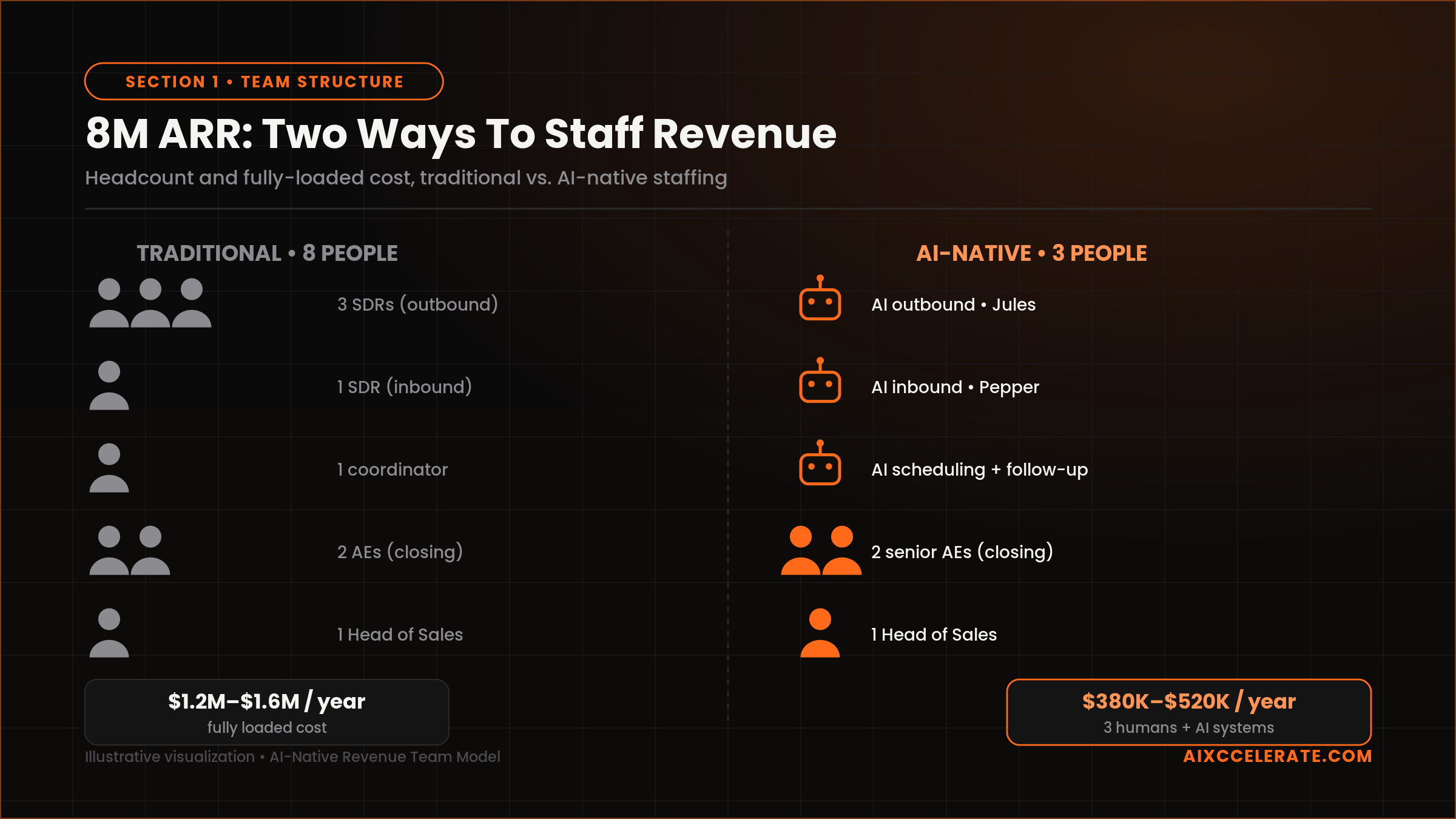
| Function | Traditional Staffing (8 people) | AI-Native Staffing (3 people) |
|---|---|---|
| Outbound prospecting | 3 SDRs | AI outbound system (Jules) |
| Inbound qualification | 1 SDR | AI inbound handler (Pepper) |
| Meeting scheduling | Reps self-manage | AI scheduling system |
| Follow-up management | Reps self-manage | AI sequence continuation |
| Sales coordination / admin | 1 coordinator | AI coordination system |
| Complex deals / closing | 2 AEs | 2 senior AEs (same) |
| Revenue leadership | 1 Head of Sales | 1 Head of Sales (same) |
Traditional team cost (fully loaded): $1.2M–$1.6M/year for 8 people.
AI-native team cost: $380,000–$520,000/year for 3 humans + AI systems.
The output is comparable or better. The cost is 60–70% lower. The structural resilience is dramatically higher — no ramp time gaps, no vacancy periods, no institutional knowledge loss when someone leaves.
Why Does Pipeline Velocity Actually Increase?
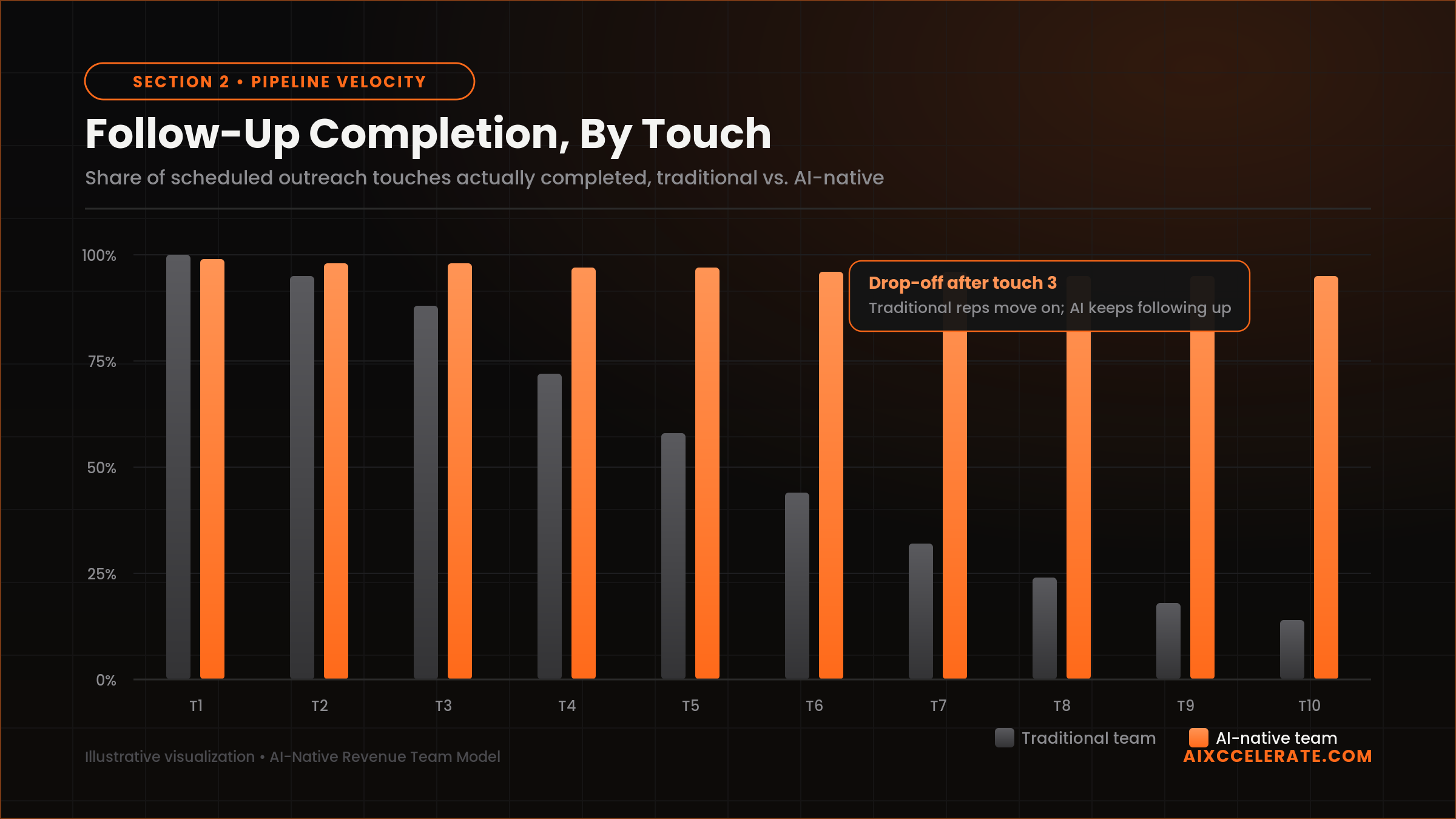
The velocity improvement comes from three structural changes.
Consistent follow-up completion. In a traditional team, follow-up completion drops sharply after touch 3 because reps move on to new prospects or get busy with other work. In an AI-native team, the AI executes all 10 touches with 95%+ completion. Prospects who were never going to respond to touch 3 respond to touch 7 — a segment of pipeline that traditional teams consistently leave on the table.
24/7 inbound coverage. A prospect filling out a form at 11pm gets qualified, a meeting gets booked, and the human rep wakes up to a pre-qualified calendar event. No wait until morning. No "I'll get to that tomorrow." The 5-minute response window is hit regardless of the time.
Zero ramp time when adding capacity. When a traditional team needs more pipeline, the answer is hiring — with a 4-5 month lag before productivity. In an AI-native team, increasing outbound volume is a configuration change. Capacity is added in days, not months.
What Are the Compounding Effects Over Time?
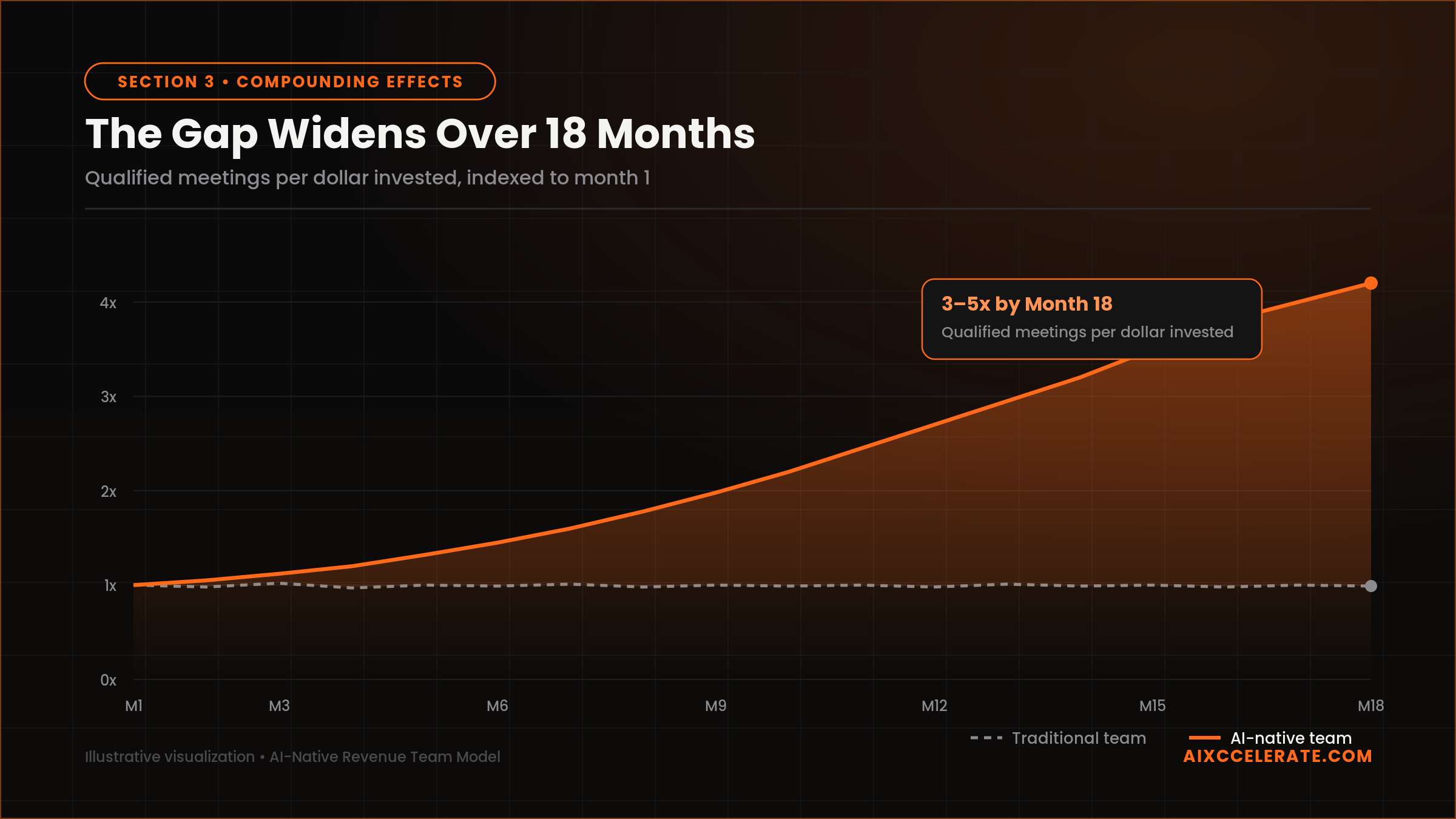
The early benefit of AI-native design is cost efficiency. The later benefit is compounding.
The AI system's performance improves as it processes more data: which sequences work for which ICP segments, which opening lines produce the best reply rates, which timing patterns correlate with conversion. This learning compounds — month 12 performance is measurably better than month 1, without adding headcount or cost.
A traditional human SDR team has no equivalent compounding effect. Each new SDR hire starts from zero. Institutional knowledge that leaves with each departure resets the clock.
By month 18, the gap between an AI-native team and a traditional team — measured in qualified meetings per dollar invested — is typically 3–5x in the AI-native team's favour.
Illustrative Example: Inside an AI-Native B2B Sales Operation
A B2B SaaS company launched in 2023 with a stated goal of reaching $5M ARR with fewer than 10 people. Structure from day 1: 2 founders + 1 SDR managing AI systems + 1 customer success manager.
Year 1: $2.1M ARR. Year 2 (added 1 AE): $5.4M ARR. Year 3: $9.2M ARR with 4 people total.
Revenue per employee (full team): $2.3M. Industry median for traditional teams at that ARR: $600K–$900K per employee. The efficiency advantage was a key feature of their Series A pitch — and was oversubscribed at a 12x revenue multiple.
For more on the 6-agent AI revenue model for SMBs, read The 6-Agent AI Revenue Team Built for SMBs.
Curious what an AI-native revenue team looks like at your ARR stage? Use the free AI Revenue Team ROI Calculator.
AI Xccelerate's Approach to AI-Native Revenue Teams
AI Xccelerate builds the AI layer of the AI-native model as a coherent system. Jules handles outbound — prospecting, sequencing, reply management, meeting booking. Pepper handles inbound — instant response, qualification, routing. Together they form the pipeline generation layer that the human team's closing capacity can focus on.
The human team at AI Xccelerate customer companies typically consists of 2–4 AEs handling discovery calls and closing, with a single SDR or RevOps person overseeing the AI systems and managing exceptions. The result: significantly more qualified pipeline, at significantly lower cost, with compounding improvement over time.
FAQ
What is an AI-native sales team?
A sales team designed from the start with AI handling all structured, high-volume, and rules-based work — prospecting, qualification, follow-up, scheduling — while human talent is exclusively focused on judgment-intensive work: complex deal management, executive relationships, discovery conversations, and negotiation.
How is this different from just "using AI tools"?
Tool adoption adds AI features to an existing process and existing team size. AI-native design starts by defining which functions require human judgment and sizes the human team accordingly — often 60–70% smaller than a traditional team doing the same revenue.
What are the most important roles to keep as humans in an AI-native revenue team?
Complex deal management and closing, strategic account relationships, escalation handling, and revenue leadership. These require the judgment, trust, and contextual reading that AI cannot yet provide.
How do AI-native companies handle warm, relationship-driven sales?
AI handles the front-end funnel — prospecting, qualification, initial engagement. Human reps take over at the relationship-intensive stage: qualified discovery calls, complex demos, negotiation, and closing. The AI creates the conditions; the human does the relationship work.
What is the minimum revenue to justify building an AI-native revenue team?
There's no hard floor. Companies at $1M ARR building AI-native infrastructure have a structural cost advantage that compounds as they grow. The practical starting point: if you're spending $100,000+ on SDR headcount or considering your first SDR hire, an AI-native alternative is worth modelling seriously.
Does an AI-native sales team work for enterprise deals?
It works for the front of the enterprise pipeline — prospecting, qualification, initial meeting booking. For late-stage enterprise deals with multiple stakeholders and complex negotiation, human sales talent remains essential. Most AI-native teams handle mid-market and SMB deals end-to-end; enterprise deals use AI for funnel-top and humans for the deal interior.
Ready to model what an AI-native revenue team looks like for your business? Book a 20-minute AI Workforce Audit