The Honest Guide to AI Sales Tools for Small Business in 2026
The AI sales tools market in 2026 is loud and confusing. This guide breaks it into 5 real categories, with honest costs and fit guidance, so small businesses buy the right tool, not the loudest one.
The AI sales tools market in 2026 is large, fragmented, and full of products that promise revenue transformation and deliver feature confusion. For a small business trying to make a sensible decision, the noise is genuinely difficult to navigate.
Every week there's a new "AI-powered" tool with a slick landing page claiming to 10x your pipeline. Most of them are sophisticated automation with AI-sounding marketing wrapped around them. A small number are genuinely different. Knowing which is which — and more importantly, knowing which category of problem you actually have — is the starting point for any useful purchasing decision.
This is an honest breakdown: what categories of AI sales tools actually exist in 2026, what each category does, who it's right for, what it costs, and what the market doesn't tell you.
TL;DR
- There are 5 distinct categories of AI sales tools, and most vendors blur category lines in their marketing — understanding the categories prevents buying the wrong thing
- The biggest mistake SMBs make: buying 4–6 point tools that don't integrate, creating more admin rather than less
- "AI-powered" is a marketing claim on most tools; actual AI capability ranges from basic automation to genuinely intelligent, agentic systems
- The best ROI for most small businesses comes from one or two well-chosen tools, not a stack of 8 that no one fully uses
- The right question isn't "which AI tool should I buy?" — it's "which part of my revenue process needs the most help right now?"
- Point tools solve point problems; if your problem is systemic, a point tool won't fix it
The 5 Categories of AI Sales Tools in 2026
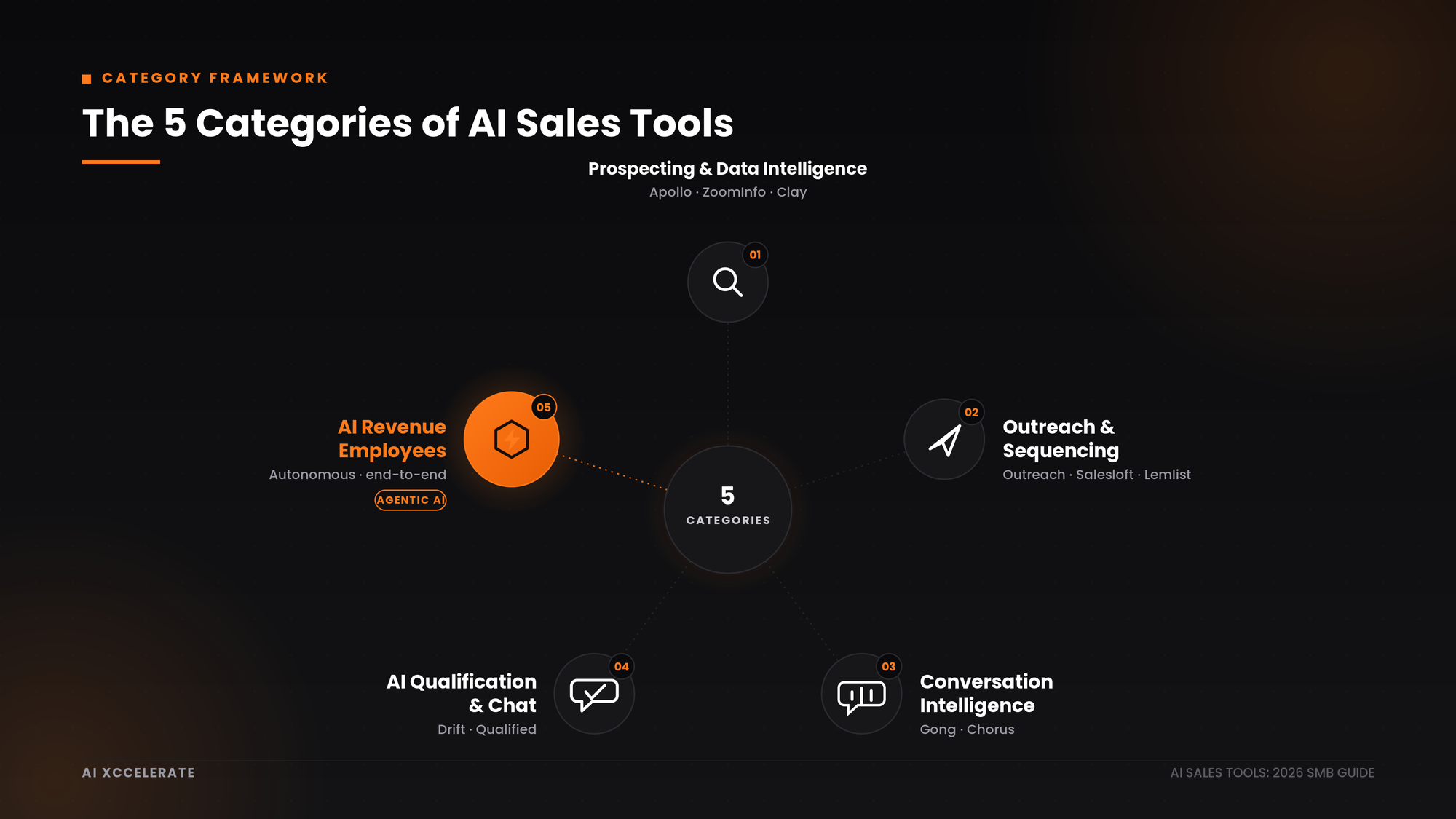
Category 1: Prospecting and Data Intelligence. Finds ICP-fit accounts, enriches contact data, identifies trigger events and buying signals. Examples: Apollo.io, ZoomInfo, Clay. These tools are good at scale but require a human to do something with the data.
Category 2: Outreach and Sequencing. Executes multi-touch outbound sequences across email and LinkedIn on a defined schedule. Examples: Outreach, Salesloft, Lemlist. Most of these use AI for copy assistance; the core function is scheduled delivery, not genuine AI.
Category 3: AI Conversation Intelligence. Records, transcribes, and analyses sales calls — identifying talk patterns, objections, competitor mentions, coaching opportunities. Examples: Gong, Chorus. Genuinely useful once you have an AE team with 15+ calls per week.
Category 4: AI Qualification and Chat. Engages inbound leads in real time, asks qualification questions, routes to human or books meetings. Examples: Drift, Qualified. Valuable for high-inbound-volume companies; less relevant if inbound is fewer than 50 leads/month.
Category 5: AI Revenue Employees. End-to-end AI systems that perform entire revenue functions autonomously — outbound prospecting through meeting booking, or inbound handling through qualification — as an integrated role, not a tool. This is the category that's changing the economics of SMB sales.
The Honest Assessment Matrix
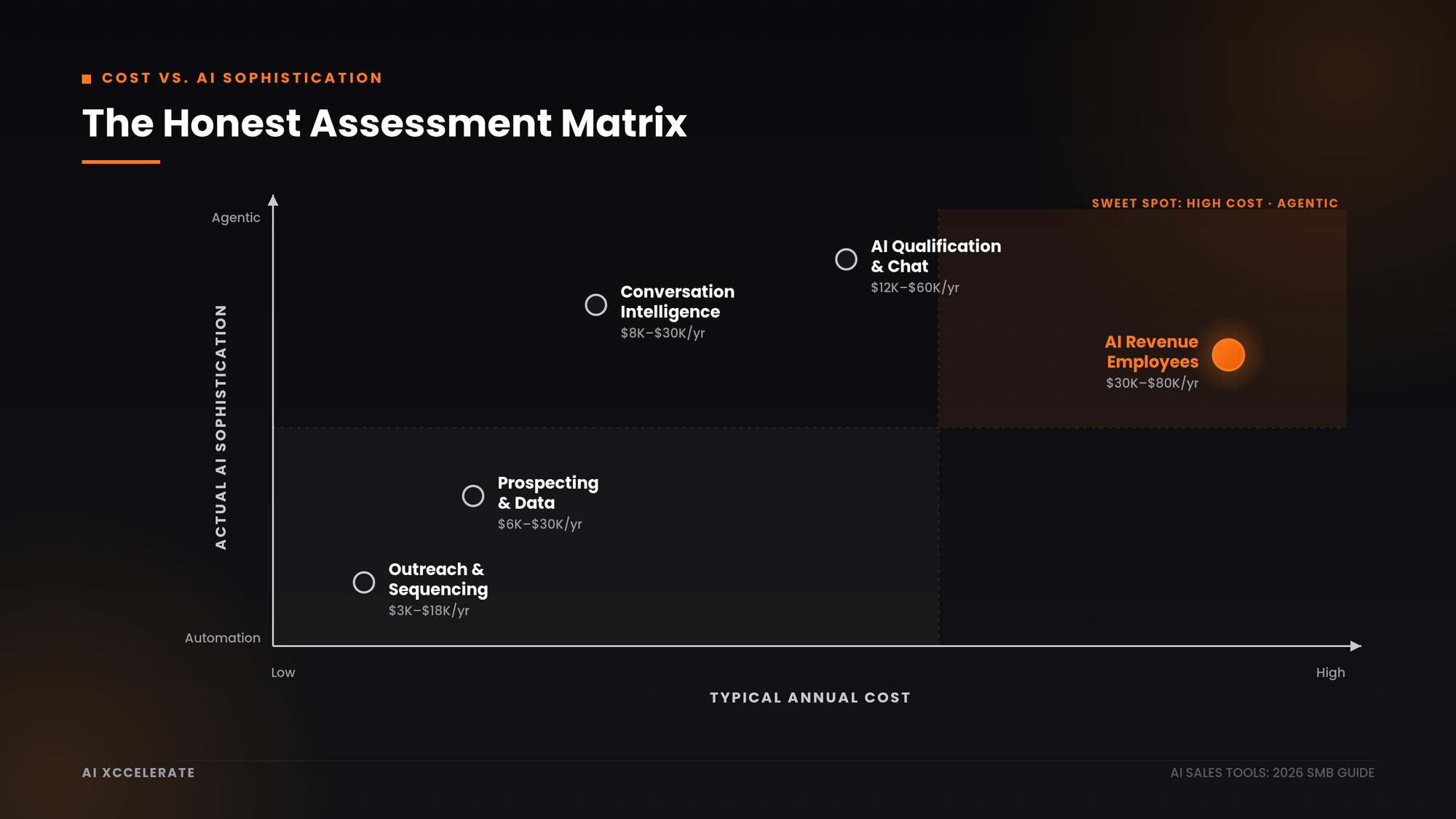
| Tool Category | Actual AI Level | Typical Annual Cost | Best Fit | Common Mistake |
|---|---|---|---|---|
| Prospecting/data | Moderate (ML-based scoring) | $6,000–$30,000 | > 100 new accounts/month needed | Buying before ICP is defined |
| Outreach/sequencing | Low (automation + AI copy) | $3,000–$18,000 | SDR process that's already working | Expecting it to replace strategy |
| Conversation intelligence | High (genuine NLP + coaching AI) | $8,000–$30,000 | AE team with 15+ calls/week | Too early in team size |
| AI chat/qualification | High (real-time conversation AI) | $12,000–$60,000 | 200+ inbound leads/month | Buying for brand signal, not volume |
| AI revenue employees | High (agentic, autonomous) | $30,000–$80,000 | Replacing/augmenting SDR function | Deploying without defined ICP |
What "AI-Powered" Actually Means on Most Vendor Pages
The term "AI-powered" has become almost meaningless in sales tool marketing. Here's what it usually means in practice:
"AI writing assistant" = GPT-based email copy generation. Genuinely useful; not actually AI in the autonomous sense.
"AI scoring" = Machine learning model trained on your historical data to predict which leads are likely to convert. Requires data to be useful; less valuable at < $3M ARR.
"AI insights" = Pattern recognition on your CRM data with automated recommendations. Works well in platforms with clean data; less useful with messy CRMs.
"Agentic AI" = A system that takes actions autonomously — researching prospects, drafting messages, sending outreach, reading replies, booking meetings — without requiring human input at each step. This is the genuinely new capability in 2026.
Most tools in categories 1–4 use the first three definitions. Category 5 tools use the fourth. The distinction determines what you can realistically expect the tool to do independently.
How to Diagnose What You Actually Need
Before buying any AI sales tool, answer three questions.
Question 1: Where exactly is pipeline breaking down? Not enough meetings, or not enough of those meetings converting to pipeline? Not enough pipeline, or not enough pipeline converting to closed deals? Each answer points to a different tool category.
Question 2: What does your current team have time to do? A sequencing tool requires someone to write sequences and manage replies. A prospecting database requires someone to build lists and interpret the data. AI revenue employees reduce the human time required — but still need a human to manage exceptions and review performance.
Question 3: Do you have the prerequisites for this tool to work? A sequencer requires good ICP and messaging to be worth buying. Conversation intelligence requires a team generating enough calls to analyse. Deploying a tool before its prerequisites are met is the most common waste in the AI tools market.
Illustrative Example: The Company That Replaced 5 Point Tools With One System
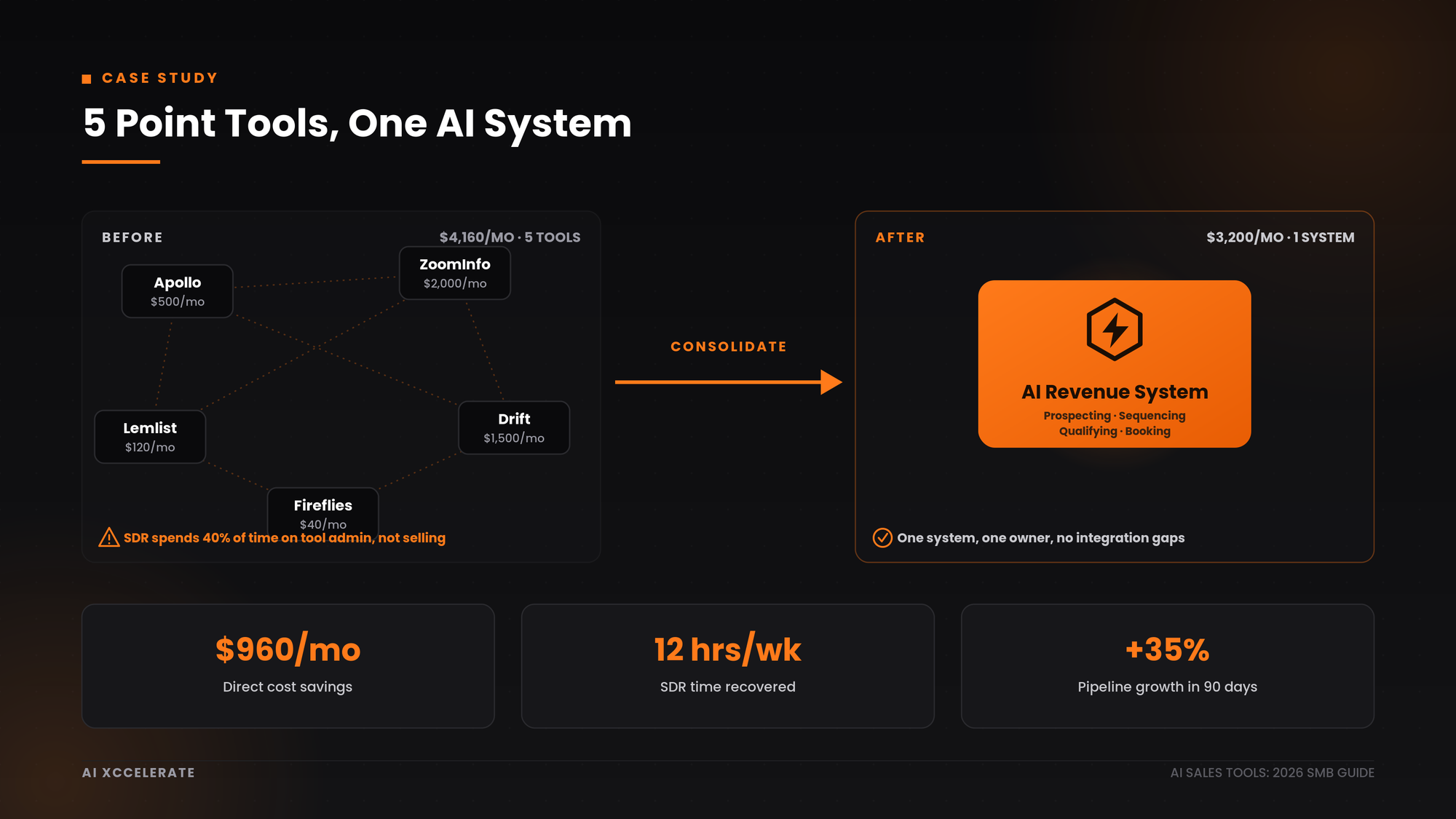
A B2B SaaS company at $4.5M ARR had accumulated: Apollo ($500/mo) + Lemlist ($120/mo) + Drift ($1,500/mo) + Fireflies ($40/mo) + ZoomInfo ($2,000/mo) = $4,160/month = $49,920/year.
Their SDR was spending 40% of their time managing these tools — importing lists between Apollo and Lemlist, troubleshooting integration failures, updating tags across platforms.
They replaced the stack with a single AI revenue employee system handling prospecting, sequencing, qualification, and follow-up. Cost: $3,200/month. SDR's tool management time dropped from 40% to 8%. Pipeline generated increased 35% in 3 months.
Savings: $960/month. Time recovered: 12 hours/week of SDR capacity. Pipeline improvement: 35%.
For a deeper comparison, read AI Employees vs AI Tools: The 2026 Buyer's Framework for SMB Leaders.
Want to audit your current AI tool stack and find the gaps? Use the free AI Revenue Team ROI Calculator.
Where AI Revenue Employees Fit in This Framework
AI Xccelerate's AI Revenue Employees — Jules (outbound), Pepper (inbound) — sit squarely in Category 5. They're not a sequencer, not a data tool, and not a chatbot. They're autonomous systems that own entire revenue functions end-to-end: Jules owns the outbound prospecting-to-meeting function, Pepper owns the inbound qualification-to-meeting function.
The practical distinction: a Category 2 sequencer sends emails; Jules reads the replies, categorises them, responds appropriately, handles objections, and books the meeting. The human is involved when there's a warm signal — not at every step.
For SMBs looking to reduce tool sprawl while increasing pipeline output, this integrated approach typically outperforms a stack of 4–6 point tools on both dimensions.
FAQ
What is the best AI sales tool for a small business in 2026?
There's no single best tool — the right choice depends on where your pipeline process is breaking down. A company with an inbound problem needs a different tool than one with an outbound problem. Start with the diagnosis, then match the tool to the problem.
How much should a small business spend on AI sales tools?
Most SMBs at $2M–$8M ARR spend $15,000–$45,000/year on their sales tool stack. The best ROI typically comes from 2–3 well-integrated tools, or one comprehensive AI revenue system that covers multiple functions. Spending $80,000 on 8 tools that don't talk to each other consistently underperforms either option.
Do AI sales tools replace the need for human salespeople?
For volume-based, routine parts of the sales role (prospecting, sequencing, qualification, follow-up), AI tools are increasingly capable of matching or exceeding human performance. For relationship-intensive, complex deal management, human salespeople remain necessary. The practical answer is: it depends on which parts of the role you're asking about.
What questions should I ask before buying an AI sales tool?
Does this integrate with my CRM? Who owns configuration and ongoing management — is it self-serve or does it require vendor support? What does "AI-powered" actually mean for this specific product feature? What's the realistic onboarding timeline before production results? Can I see results from a company similar to mine?
What is the difference between AI automation and genuine AI in sales tools?
Most "AI-powered" tools are sophisticated automation: rule-based workflows with AI-generated copy. Genuine AI involves systems that observe context, make decisions, and take action without explicit human rules for every scenario. Agentic AI systems that read a reply and decide how to respond are genuinely AI; email sequences that fire on a schedule are automation.
How do I avoid tool sprawl when building my AI sales stack?
Start with the single biggest bottleneck in your revenue process. Buy one tool to address it. Measure for 90 days. Then address the next bottleneck. Resist the temptation to build a comprehensive stack before you have the process sophistication to use it — most SMBs add tools faster than they add the process maturity to benefit from them.
Want help selecting the right tools for your revenue process? Book a 20-minute AI Workforce Audit