Why AI Isn't Working for Your Business Yet (And What the July 2026 Data Actually Shows)
Most companies haven't operationalized AI, they've just tried it. Here's what's actually separating the 11% who have from everyone else.
You bought the tool. You ran the pilot. Your team used it for a few weeks, got a modest bump, and then things quietly went back to normal.
If that sounds familiar, you're not doing anything wrong — you're just early in a phase almost every company is stuck in right now. New data from July 2026 shows that only around 11% of large companies have deeply woven AI into how they actually run the business. Everyone else is still experimenting. The gap between those two groups is no longer about which AI model someone uses. It's about what happens after the model is chosen.
TL;DR
- Foundation models (GPT, Claude, Gemini, and a wave of Chinese labs) are becoming interchangeable — the competitive edge has moved to workflow, memory, and integration
- Only about 11% of large enterprises have deeply operationalized AI; most are still in the experimentation phase
- Cost efficiency — not raw model size — is now the dominant conversation among AI leaders
- Meta's entry into paid enterprise AI APIs signals that price competition is about to intensify sharply
- A recent longitudinal study found sustained AI coding adoption was associated with roughly double the engineering output at one organization
- Enterprise buyers increasingly judge AI on uptime and measurable outcomes, not launch-day demos
Why do so many companies feel like AI isn't paying off?
The honest answer is that most companies haven't crossed the line from using an AI tool to running an AI operating model. Using AI here and there, in a few workflows, isn't the same as building AI into how work actually gets done. That distinction explains almost every "AI isn't working" complaint founders and operators are voicing this year.
It also reframes the problem in a useful way. If only 11% of large companies have made that leap, then falling short of AI's promise isn't a signal that something is broken. It's a signal that most businesses are simply standing at the starting line of a much longer race.
Why do all the AI models suddenly feel the same?
Enterprise buyers have stopped asking which model is smartest. They're asking which system actually fits into how their business runs. That shift matters because it means the foundation model itself — OpenAI's, Anthropic's, Google's — is being treated more like a commodity, similar to how cloud compute became a commodity a decade ago.
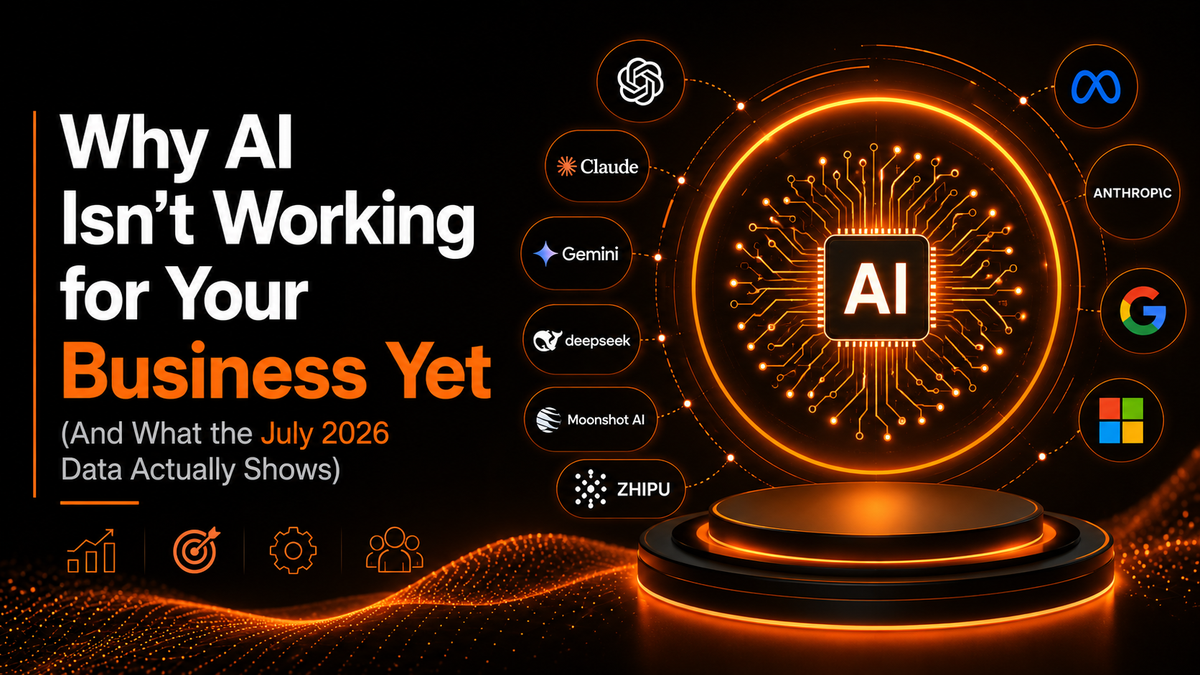
Part of the reason is the sheer number of capable options now on the table. Meta, Moonshot AI, Zhipu, DeepSeek, and several other labs are releasing models that are closing the capability gap fast, while undercutting on price. When five or six vendors can all do "good enough" reasoning, price and integration decide the winner — not benchmark scores.
For a founder deciding where to spend the next quarter's AI budget, this is good news. It means you're no longer locked into one expensive vendor to get solid performance. The leverage has shifted toward the buyer.
Why is everyone suddenly talking about AI cost instead of AI power?
Anthropic's own leadership addressed this directly this month: companies aren't trying to use less AI. They're trying to spend less to get the same result. That's a meaningfully different problem, and it's reshaping how AI systems get built.
Concretely, this shows up as smarter routing — sending a simple task to a smaller, cheaper model and reserving the expensive model for the moments that actually need heavyweight reasoning. It's the same instinct behind hiring: you don't put your most expensive person on data entry.
For a business owner, this is the difference between an AI bill that scales linearly with usage and one that scales with actual value delivered. That distinction alone can be worth tens of thousands of dollars a year at moderate usage volumes.
What does Meta charging for AI access actually change?
Meta's biggest AI news this month wasn't a new model — it was the decision to start charging businesses for API access to its Muse Spark 1.1 and Meta Model API. That's a real pivot from "AI as a free feature" to "AI as a revenue line," and it puts Meta in direct pricing competition with OpenAI, Anthropic, and Google.
The practical effect for buyers: expect aggressive price competition over the next two quarters as Meta tries to buy market share. If you're evaluating vendors right now, price movement is likely, and locking into a long contract at today's rates may not be the best move.
What is Google actually building, if not "another model"?
Google's announcements this month leaned almost entirely toward enterprise deployment — governance, security, safety tooling, and education, rather than a splashy new model release. That's a deliberate repositioning: from "we build the smartest model" to "we help you deploy AI safely at scale," which mirrors the playbook Microsoft has run for years.
There's a lesson in that shift for smaller companies too. The businesses winning right now aren't necessarily the ones with access to the newest model. They're the ones that have figured out governance, security, and reliable deployment around whichever model they're using.
Why does every AI conversation now mention "agents"?
Across nearly every major release this month — from OpenAI's GPT-5.6 family to Google's Gemini 3.x line to Meta's agentic coding push — the conversation has moved past "what can this model say" to "what can this system actually do on its own." Tool use, multi-step planning, and long-running task execution are now the headline features, not raw language ability.
This is the quiet but massive shift: the frontier model race is becoming an agent platform race. A model that can reason brilliantly but can't take five actions in a row to close a task isn't as valuable to a business as one that reasons adequately and finishes the job.
The July 2026 model landscape, at a glance
| Company | What shipped | Enterprise emphasis |
|---|---|---|
| OpenAI | GPT-5.6 family (Sol, Terra, Luna) | Lower cost, agent workflows, production reliability |
| Anthropic | Claude Sonnet 5 | Coding strength, improved tool use, lower pricing |
| Gemini 3.x line | Governance, safety tooling, enterprise platform depth | |
| Meta | Muse Spark 1.1 + paid API | Agentic coding, custom chip strategy, first real enterprise monetization |
| Moonshot AI | Kimi K3 | Cost-competitive open-style release |
| Zhipu | GLM-5.2 | Continued commoditization pressure from Chinese labs |
Does AI actually move the needle on something as concrete as engineering output?
This is where the data gets genuinely compelling. A recent longitudinal study of sustained AI coding adoption found roughly a doubling of engineering throughput at one organization over time, alongside a shift toward more automated code review. It's a single case study, not a universal guarantee — but it's one of the clearest pieces of enterprise-grade evidence published so far that disciplined AI adoption produces real, measurable output, not just anecdotal enthusiasm.
The word "disciplined" matters here. The gains showed up over time, with structure around how the AI was used — not from simply handing engineers a chatbot and hoping for the best. That's the same 11%-versus-89% gap showing up again, just inside one function instead of across a whole company.
What do enterprise buyers actually care about now?
Not benchmark charts. Not launch livestreams. Not demo videos. The businesses actually signing contracts this year are asking about uptime, governance, return on investment, and whether their own people actually adopt the tool day to day. One recent industry analysis put it plainly: enterprise buyers care more about Monday morning than launch day.
That's a useful gut check for any company evaluating a new AI vendor or building an internal AI strategy. If a pitch leans heavily on how impressive the model is in a demo, and lightly on what happens in week six of actual use, that's worth pausing on.
A quick way to picture this
Imagine two CROs, both with 40-person sales teams, both licensing the same AI tools in January. CRO A rolls the tool out to the whole team at once with no defined workflow — "just use it when it's useful." Six months later, usage has quietly dropped to a handful of power users, and the CRO can't point to a single number that changed. CRO B assigns the AI a specific, narrow job — drafting the first pass of every follow-up email within two hours of a call — and tracks one metric: time-to-follow-up. Six months later, that number has dropped from 31 hours to 4, and the team has expanded the AI's job description twice since.
Same tools. Same budget. The difference is entirely in whether AI became part of the operating model or stayed a feature people could ignore.
Want the exact framework we use to decide which tasks are worth automating first? Download the AI Task Prioritization Worksheet — it's the same scoring model we walk founders through before any AI rollout.
So what does "operationalizing AI" actually look like in practice?
This is where the idea of an AI Employee — rather than an AI tool — starts to make more sense. A chatbot that someone has to remember to open is a feature. Something that shows up to a defined role every day, with a specific job and a specific output, functions more like a hire than a tool.
That's the model behind AI Xccelerate's approach: instead of deploying a general-purpose assistant and hoping teams adopt it, AIX builds named AI Revenue Employees with specific jobs — Jules handles a defined piece of the pipeline, Pepper owns another, and so on through Tony, Joy, George, and Nick. Each one is scoped narrowly enough that "did it work" has a real, measurable answer, the same way CRO B's follow-up-time metric did in the example above.
The point isn't that AIX has the smartest model — as the last ten data points show, model intelligence is rapidly commoditizing anyway. The point is that a scoped role with a clear output is what actually crosses the gap between "we tried AI" and "AI runs part of our business." That's the 11% club, and it's built on workflow design, not benchmark scores.
If your team has already tried the general-purpose chatbot route and hit the same plateau most companies hit, the fix usually isn't a better model. It's narrowing the job description until the results become measurable again.
See what a defined AI Revenue Employee role actually looks like in your pipeline — book a 20-minute walkthrough and we'll map one specific role against your current sales or CS process, no generic demo included.
FAQ
Why hasn't AI improved my business results yet? Most companies are using AI as a general tool rather than assigning it a specific, measurable job. Research this year shows only about 11% of large companies have deeply operationalized AI into their processes — everyone else is still in the experimentation phase, which is why results often plateau after an initial bump.
Is one AI model actually better than the others in 2026? Enterprise buyers are increasingly finding that leading models perform similarly enough that the model choice matters less than how it's integrated, routed, and deployed. Price and workflow fit now drive vendor decisions more than raw benchmark performance.
Why is everyone talking about AI cost instead of AI capability? Because most companies already have enough AI capability for their current needs — the open question is how to get that capability at a lower, more predictable cost. This has pushed the industry toward routing tasks to cheaper models when a full-power model isn't needed.
What is an "AI agent" and why does it matter more than the model itself? An AI agent is a system that can take multiple actions toward a goal — using tools, planning steps, and completing tasks — rather than just answering a question. The industry is shifting from single-response chatbots toward agents precisely because businesses need completed work, not just good answers.
Does AI coding adoption actually produce measurable results? A recent longitudinal case study found engineering throughput roughly doubled at one organization after sustained, disciplined AI coding adoption. It's one data point rather than a universal guarantee, but it's among the clearest evidence yet that structured adoption — not casual use — is what drives real gains.
What should I actually look for when evaluating a new AI vendor? Enterprise buyers now prioritize uptime, governance, and measurable ROI over demo polish. Ask any vendor what a typical customer's results look like in week six of use, not just what the tool does in a live demo.
What's the difference between an "AI tool" and an "AI Employee"? An AI tool is something a team has to remember to use, with no fixed scope. An AI Employee is assigned a specific, narrow role with a clear, trackable output — which is what makes it possible to actually measure whether it's working.