What Is an AI SDR and Should Your Company Have One?
AI SDR means different things to different vendors — a sequencer to some, a fully autonomous outbound system to others. Here's what the term actually means, what it costs, and what it still can't do.
The term "AI SDR" is everywhere in sales conversations right now — but the definitions vary wildly. Some vendors use it to describe a sequencing tool that sends emails automatically. Others mean something closer to a fully autonomous outbound system that manages the complete top-of-funnel workflow.
This definitional confusion matters because the two things are not the same, don't cost the same, and don't produce the same outcomes. A company that buys a sequencer expecting an autonomous AI SDR will be disappointed. A company that understands what the best systems actually do can make a genuinely informed comparison against their current human SDR cost.
This is a plain-language guide to what an AI SDR actually is in 2026, what it can and can't do, how much it costs, and the questions you need to answer before deciding whether your company needs one.
TL;DR
- An AI SDR is a purpose-built system that performs the outbound prospecting and qualification functions of a traditional human SDR
- The best AI SDRs are autonomous: they manage the full top-of-funnel workflow including responding to replies, handling objections, and booking qualified meetings without human intervention at each step
- An AI SDR does not close deals, build long-term relationships, or navigate complex organisational politics — those remain human functions
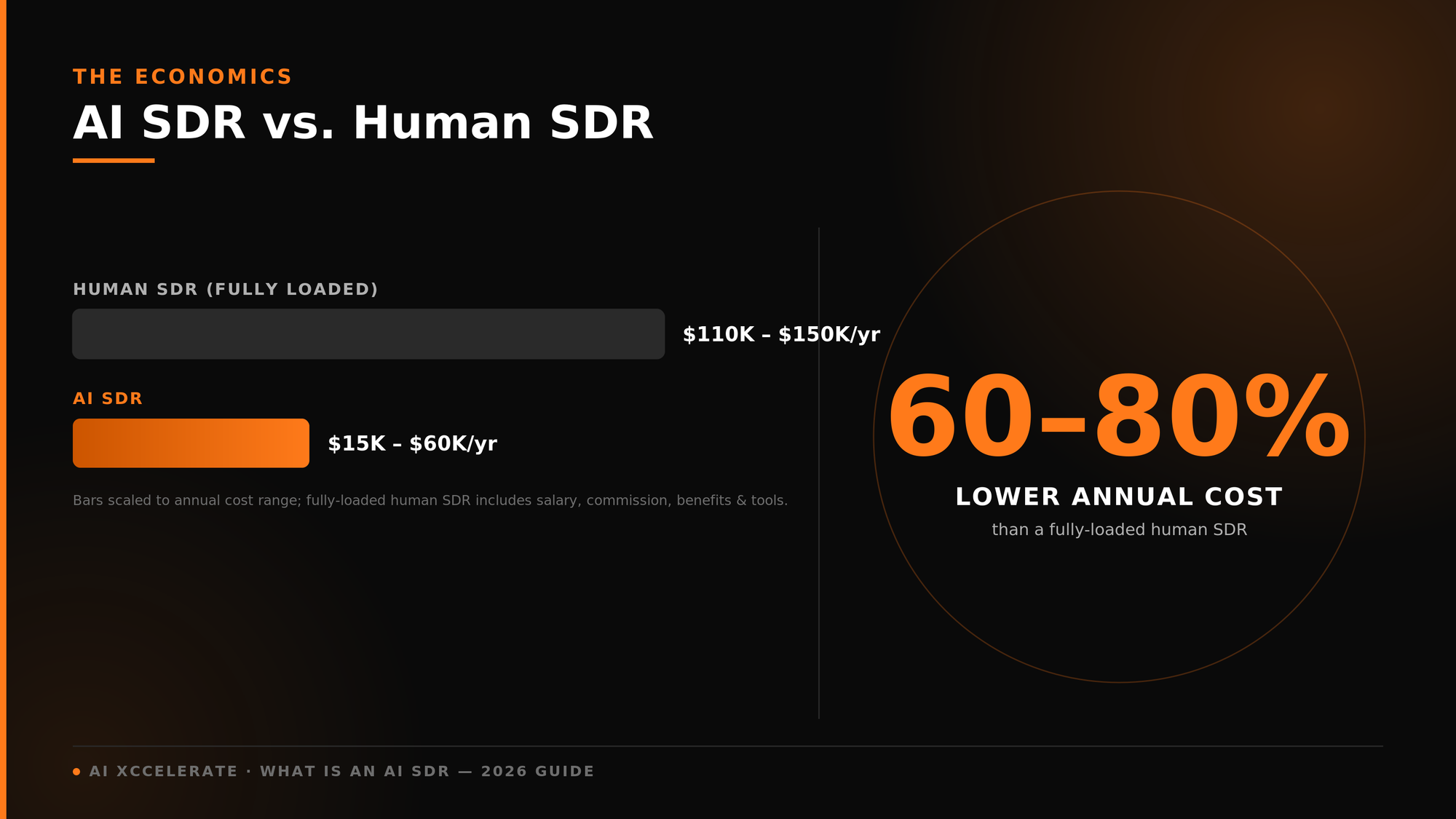
- Cost: $15,000–$60,000/year vs. $110,000–$150,000/year for a human SDR fully loaded — a 60–80% reduction
- The right question before buying: is your pipeline bottleneck in the volume and consistency of top-of-funnel activity?
- Not every company needs an AI SDR — but every company should understand what one does before deciding
What Exactly Does an AI SDR Do?
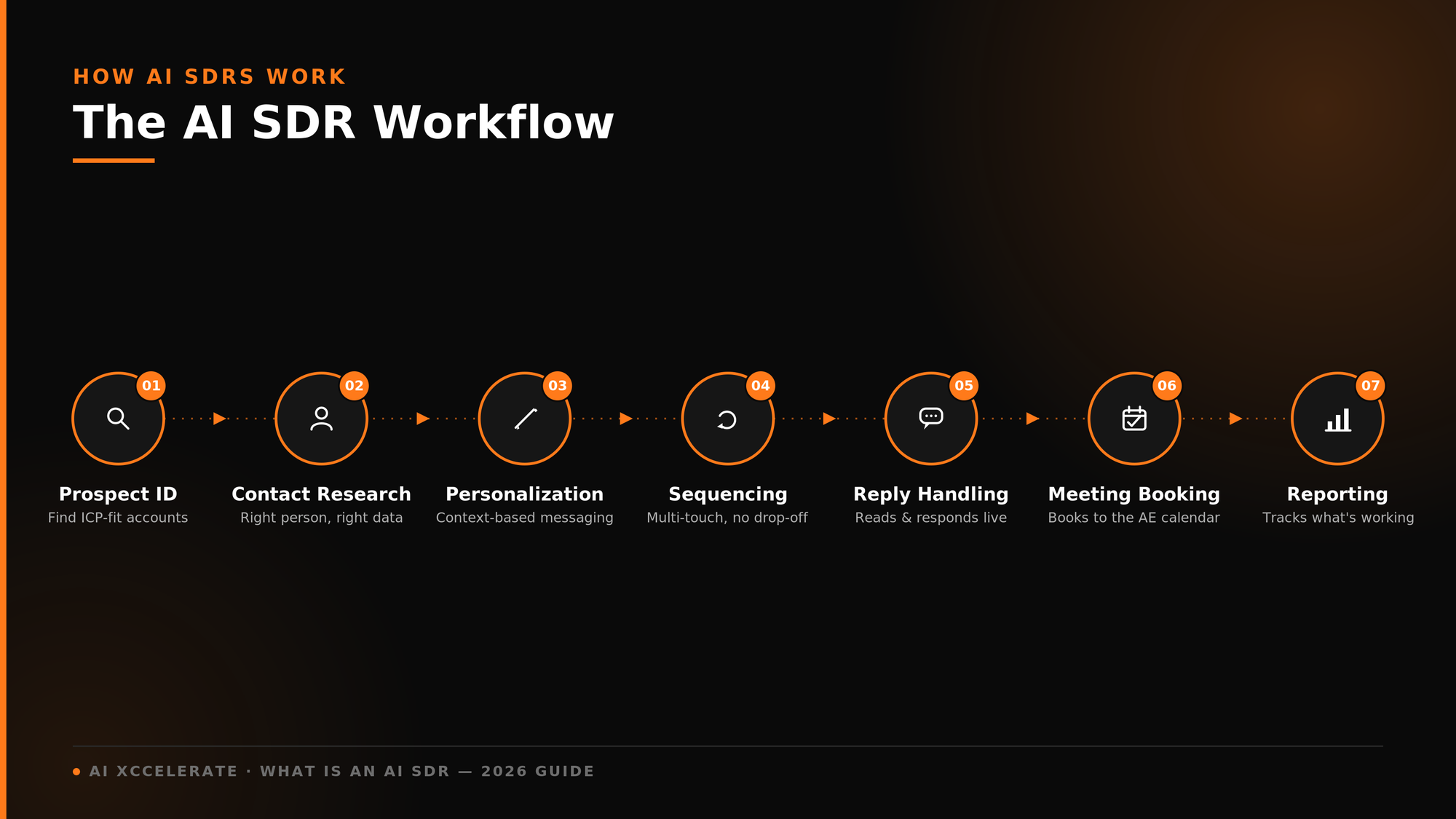
Prospect identification. Searches databases, LinkedIn, and intent signals to identify accounts matching your ICP, prioritising those showing active buying signals — headcount growth, leadership changes, funding announcements, compliance deadlines.
Contact research. Identifies the right decision-maker within each account, enriches contact data (email, LinkedIn, role), and surfaces relevant context for personalisation — recent posts, company announcements, industry events.
Outreach personalisation. Generates personalised first messages that reference specific company context relevant to the prospect's role and current situation. Not mail merge — actual contextual personalisation based on observable data.
Sequence execution. Executes multi-touch sequences across email and LinkedIn without abandonment. Touch 8 runs as reliably as touch 1, regardless of the AI's "mood" or workload.
Reply handling. Reads incoming replies, categorises them (positive interest / timing objection / budget objection / not the right person / not interested), and responds appropriately — advancing positive intent toward a meeting and addressing objections with relevant information.
Meeting booking. For qualified responses, proposes meeting times that fit both the prospect's indicated availability and the human AE's calendar, sends invites, confirms bookings, and logs everything in the CRM.
Reporting. Logs all activity, tracks sequence performance by step, and provides visibility into what's working — which opening lines, which subject lines, which sequences are producing the best results.
The Economics: AI SDR vs. Human SDR
| Metric | Human SDR | AI SDR |
|---|---|---|
| Annual cost (fully loaded) | $110,000–$150,000 | $15,000–$60,000 |
| Time to full productivity | 4–5 months ramp | Day 1 — no ramp required |
| Annual attrition risk | 35–45% | Zero |
| Follow-up completion rate | 35–50% of sequences completed | 95%+ completion rate |
| Working hours per week | 40 hours | 168 hours (always on) |
| Meetings booked per month (at scale) | 12–18 | 15–30+ |
| Knowledge loss when they leave | High — sequences, context, relationships | Zero |
The economics comparison explains why AI SDR adoption is accelerating: not because the AI is always better at the relationship aspects, but because it's consistently better at the volume and consistency aspects — and those are the ones that actually constrain pipeline at most SMBs.
What Doesn't an AI SDR Do?
Discovery calls. The AI gets the meeting booked. The discovery call — the conversation that determines whether there's a real opportunity — belongs to the human AE.
Complex objection navigation in live conversations. The AI handles objections in written back-and-forth (timing, budget, priority). Real-time objection handling in a live conversation requires human judgment.
Relationship-building over time. The AI creates the conditions for humans to build relationships — by getting qualified prospects to the discovery call — but doesn't build the multi-year trust relationships that come from a human rep who knows the customer's business inside out.
Enterprise deal navigation. Multi-stakeholder, multi-month enterprise deals with political complexity require a human who can read organisational dynamics and adapt in real time.
Illustrative Example: The $6M ARR Company That Ran the Test
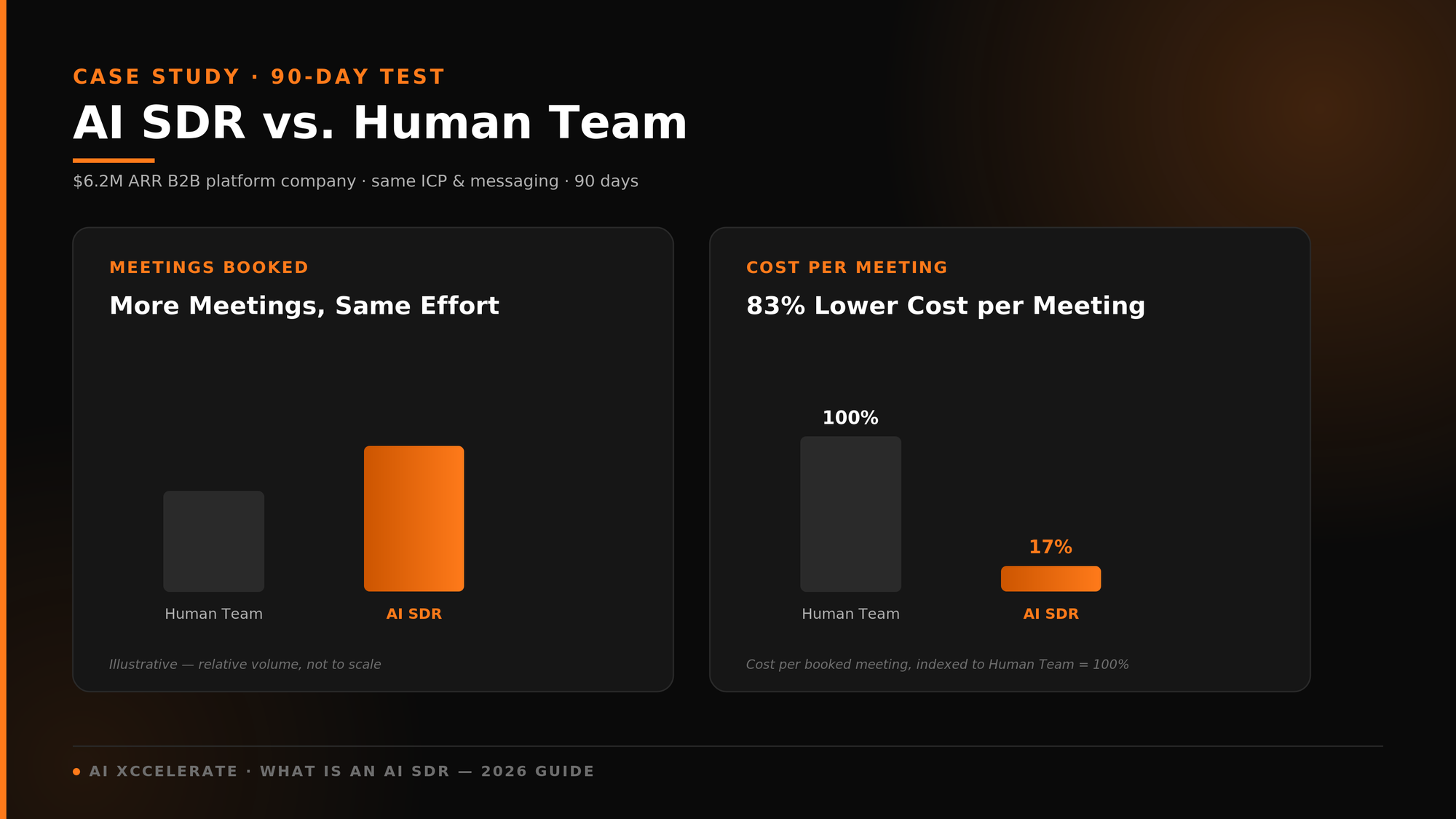
A B2B platform company at $6.2M ARR ran a 90-day test: half of outbound volume by their existing SDR team, half by an AI SDR system, with the same ICP and messaging for both.
| Metric | Human SDR Team | AI SDR System |
|---|---|---|
| Prospects contacted per month | 380 | 620 |
| Meeting booking rate | 3.8% | 4.2% |
| Meetings booked per month | 14.4 | 26 |
| Monthly cost | $10,400 (1.5 SDRs) | $3,200 |
| Cost per meeting booked | $722 | $123 |
The AI SDR booked more meetings at 17% of the cost per meeting. The human team was reassigned to reply management, inbound qualification, and AE support — functions that used their judgment rather than their volume capacity.
For the full cost breakdown, read AI SDR Cost in 2026: A Real TCO Breakdown vs a Human SDR.
Want to see what an AI SDR would cost vs. your current setup? Use the free AI Revenue Team ROI Calculator.
Jules: AI Xccelerate's AI SDR
AI Xccelerate's outbound AI agent Jules is a Level 5 AI SDR — not a sequencer or a scheduling tool, but a system that handles the full top-of-funnel workflow autonomously. Jules identifies ICP-fit prospects, researches contact data, personalises outreach based on company-specific context, executes sequences reliably across all touches, reads and responds to replies, handles common objections, and books meetings directly to the human AE's calendar.
Jules operates at scale (200–600 prospects per month), produces consistent output 7 days a week, and has zero ramp time, zero attrition, and zero institutional knowledge loss. Companies using Jules are generating 20–35 qualified meetings per month at a cost per meeting significantly below what a human SDR team would produce.
FAQ
What does an AI SDR do that a regular email sequencer doesn't?
A sequencer sends pre-written emails on a schedule — it's a timer and a delivery mechanism. An AI SDR reads and responds to replies, handles objections contextually, qualifies responses based on what the prospect said, and books meetings autonomously. The sequencer is passive; the AI SDR is an active agent.
How does an AI SDR personalise outreach without a human writing each email?
Using contextual data: company news, LinkedIn activity, job postings, funding announcements, and trigger events specific to each target account. The AI generates an opening line specific to each target based on this data, with the rest of the sequence adapting based on how the prospect responds.
Can an AI SDR respond to replies in real time?
Yes. The best AI SDR systems read incoming replies and generate contextually appropriate responses — advancing positive intent toward a meeting and addressing objections with relevant information — typically within minutes of the reply arriving.
What CRM does an AI SDR work with?
Most integrate with Salesforce, HubSpot, and Pipedrive. The AI logs all activity, updates contact records, tracks sequence progress, and creates meeting opportunities directly in the CRM.
Is an AI SDR appropriate for a company with no existing SDR?
Often yes. If a company can't yet justify a $110,000+ human SDR hire, an AI SDR can start generating pipeline at $15,000–$30,000/year — typically producing results faster (no ramp) at significantly lower cost.
How do I know if my company is ready for an AI SDR?
Readiness checklist: defined ICP with trigger events, a product that can be explained in a cold email, an AE or founder with calendar space for discovery calls, a functional CRM, and a clear definition of a "qualified meeting." These are the prerequisites — the AI SDR will generate pipeline based on these inputs.
Ready to explore whether an AI SDR is right for your pipeline? Book a 20-minute AI Workforce Audit