What Digital Agencies Get Wrong About Sales — And How AI Fixes It
Digital agencies are brilliant at selling for clients and bad at selling themselves. Here's why agency new business development always stalls—and how top agencies fixed it in 2026.
Digital agencies are brilliant at selling their clients' services. They're notoriously bad at selling their own. The industry has a saying: the cobbler's children have no shoes. Agency new business development is typically underfunded, inconsistent, and the first thing to be deprioritised when client work gets busy.
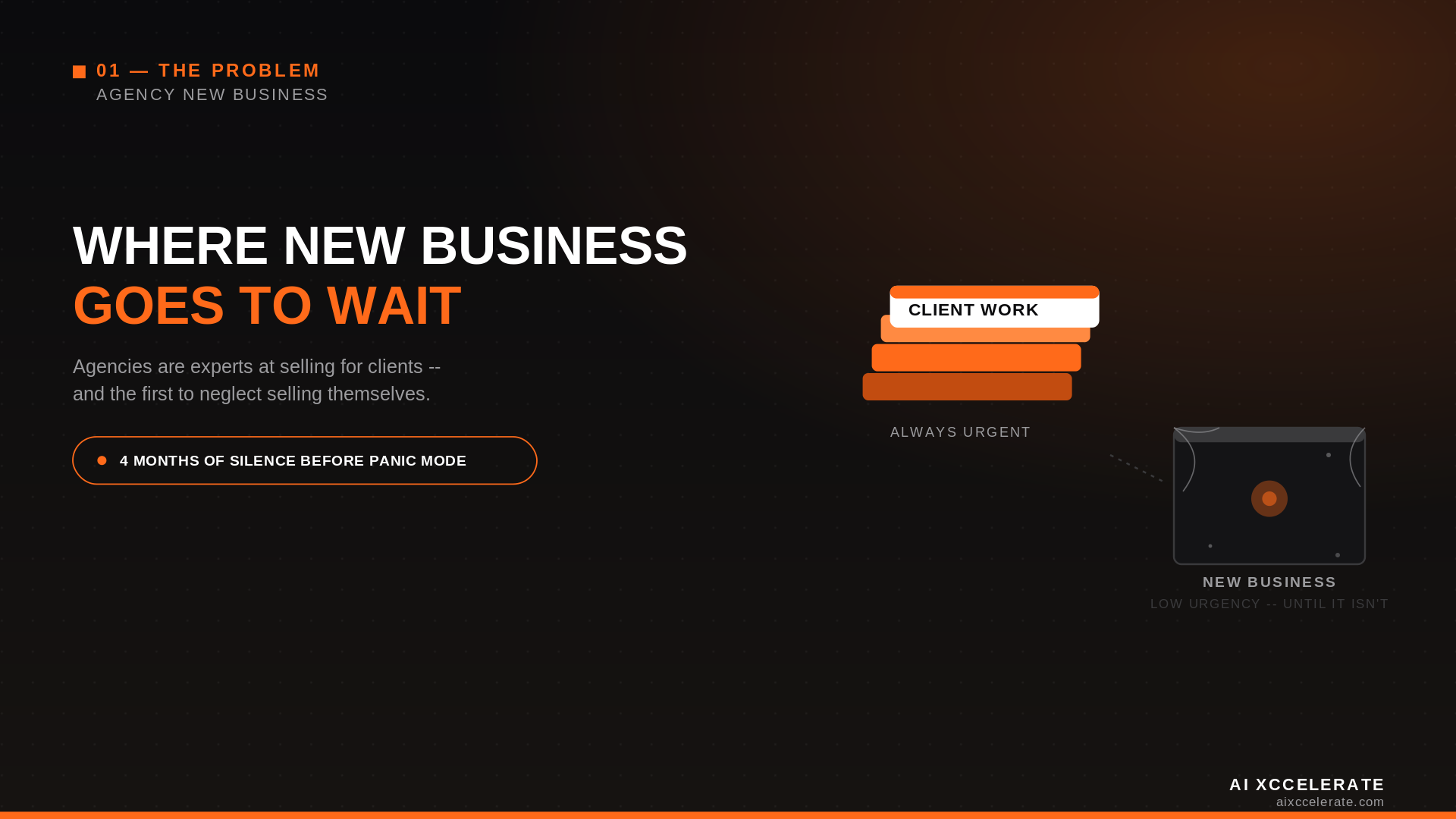
The problem isn't talent. Agency owners understand selling. The problem is structural: the people who could generate new business are the same people keeping existing clients happy, and existing clients always win the priority battle. New business is low-urgency until it suddenly isn't — and by then the pipeline has been empty for 4 months and the agency is in panic mode.
The agencies growing fastest in 2026 have solved this — not by hiring more business development staff, but by systematising the parts of new business development that were always going to be automated eventually. The result is a pipeline that runs independently of whether the owner had a slow week.
TL;DR
- Digital agencies consistently under-invest in their own new business development — the very expertise they sell to clients
- Agency new business pipeline is almost always founder/owner-dependent: when they're busy with clients, BD stops entirely
- The three most common agency BD failures: no systematic outreach, no follow-up process for "not now" prospects, and no qualification before investing in proposals
- Trigger events for agency pipeline are specific and observable: new CMO hire, product launch, rebrand project, failed campaign, new funding
- AI-assisted outbound lets agency owners maintain consistent BD activity even when deep in client delivery — 30–45 minutes/day instead of 3–4 hours
- Agencies that systematise their new business pipeline grow faster and become significantly less vulnerable to client churn crises
What Makes Agency Sales Uniquely Difficult?
Three structural features make agency new business development harder than most B2B selling.
Deliverability depends on the same people doing BD. Unlike a SaaS company where the product runs independently, an agency's service is its people. The senior people who win new business are the same people executing client work. There is no separation. When the book is full, new business stops.
The sales cycle is long and relationship-driven. Agencies don't get bought out of a cold email. The agency relationship is built over months — trust earned through relevant content, consistent follow-up, and being present when the timing is right. This requires consistent activity over long periods, which is exactly what agency owners are worst at when client work is busy.
Proposals are expensive to produce. A full agency proposal takes 8–16 hours of senior time. Investing that kind of time in an unqualified prospect is a significant cost — which creates pressure to write proposals for everyone, or to avoid prospecting altogether until qualification can happen in person.
What Triggers an Agency Buying Decision?
| Trigger | What It Signals | Observable Source |
|---|---|---|
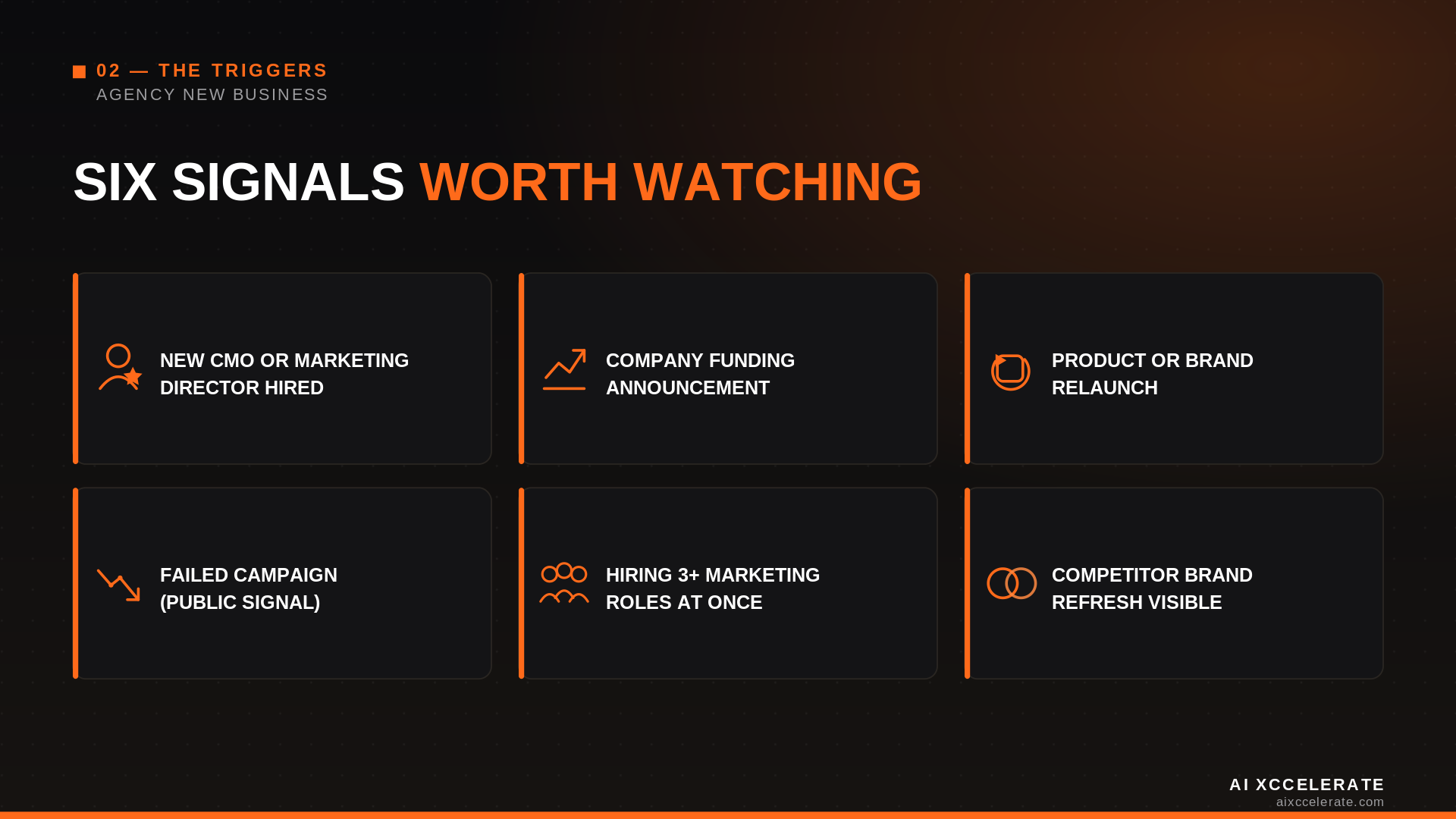
| New CMO / Marketing Director hired | Evaluating all existing vendor relationships | LinkedIn hire announcement |
| Company funding announcement | Marketing budget expanding, growth mode | PR, Crunchbase, LinkedIn |
| Product or brand relaunch | Agency review underway or imminent | Product launch PR, job postings |
| Failed campaign (public signal) | Disappointment with current agency — evaluation triggered | Social media, ad transparency tools |
| Hiring 3+ marketing roles simultaneously | Building internal team, may need strategic agency support | Job postings on LinkedIn |
| Competitor brand refresh visible | Category pressure to update positioning | Competitor site/social monitoring |
An outreach message that references a specific trigger event — "I noticed you hired a new CMO last month — agencies often get reviewed in the first 90 days of a new marketing leader's tenure, and I wanted to reach out before that window closes" — is fundamentally different from "We're a full-service digital agency that works with companies like yours."
The Three Things Most Agencies Do Wrong in New Business
Wrong thing 1: No systematic outreach. BD happens when the owner has time, which means it's sporadic and reactive. The 20 emails sent on a slow Friday generate 3 replies and one meeting, and then silence for 6 weeks. Sporadic outreach produces sporadic results.
Wrong thing 2: No nurture for "not now" prospects. An agency that puts 50 "warm" prospects in a spreadsheet and forgets them is leaving significant revenue on the table. The CMO who said "call me in Q3" after a great introductory call is one of the highest-value prospects in your pipeline — if you actually call them in Q3 with context. Most agencies don't. Monthly, relevant, low-effort touches keep the relationship warm until the timing is right.
Wrong thing 3: Proposing too early. Agencies frequently invest 8–12 hours in a full proposal before properly qualifying whether the prospect has confirmed budget, timeline, and decision-making authority. The qualification can happen in 20 minutes over the phone. The proposal without it can cost 12 hours and produce nothing.
What Does a Good Agency BD System Look Like?
A functional agency BD system has three components.
Component 1: Trigger-event monitoring. A list of 50–150 target companies monitored for specific observable signals (CMO hire, funding, rebrand, job postings). When a signal fires, outreach begins within 5 days.
Component 2: A 6-month nurture track for "not yet" prospects. Every qualified prospect who isn't ready enters a structured nurture sequence: 1 relevant touch per month (specific article, case study, market insight). Each touch is low-effort and can be scheduled or automated. At the re-engage date, the system surfaces an alert with full context.
Component 3: Qualification before proposal. A 20-minute qualification call that confirms: confirmed budget range, confirmed timeline, confirmed decision-maker involvement. No full proposal without all three confirmed.
Illustrative Example: The 12-Person Agency That Built a 90-Day New Business Pipeline
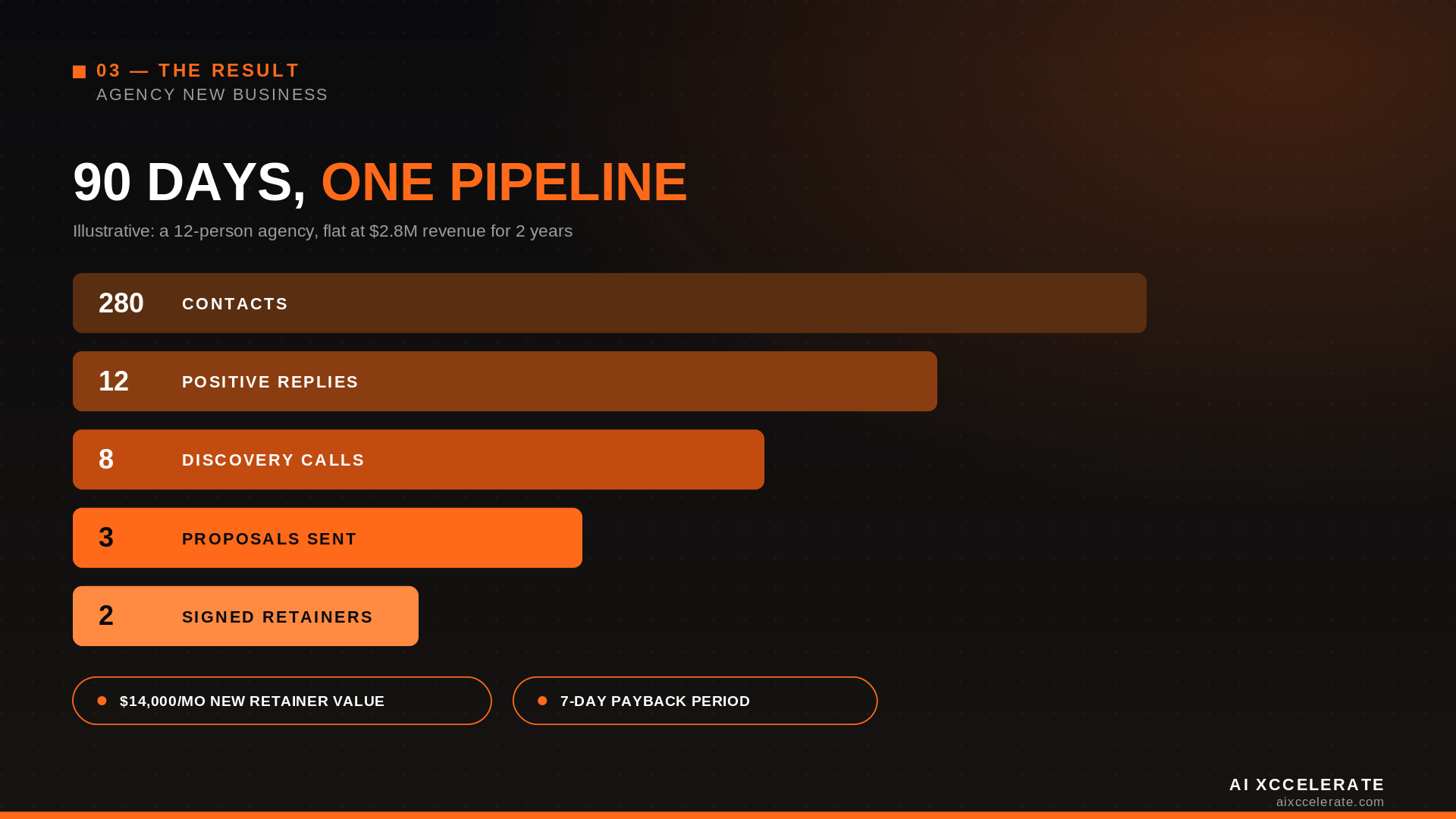
A 12-person digital marketing agency at $2.8M revenue had been flat for 2 years. All new business came from referrals. When the founder was in delivery, BD stopped.
They implemented a trigger-event monitoring and outreach system: identifying companies that had recently hired a new CMO or Head of Marketing within the previous 30 days, sending 8-touch sequences that led with specific relevant case studies.
In 90 days: 280 contacts, 12 positive replies, 8 discovery calls, 3 proposals, 2 signed retainers. New retainer value: $14,000/month. Program cost: $3,400. Payback period on the first retainer alone: 7 days. The founder's time commitment: 30 minutes/day reviewing replies and attending discovery calls.
For the AI revenue model, read Assist, Augment, or Replace: How SMBs Should Deploy AI Workforce in 2026.
Want to model what systematic new business development could add to your agency? Use the free AI Revenue Team ROI Calculator.
How AI-Assisted Outbound Changes the Agency BD Problem
The core issue with agency BD isn't willingness — it's time and consistency. Agency owners understand exactly what good BD looks like. The problem is executing it consistently when client work competes for every hour.
AI Xccelerate's outbound AI agent Jules handles the prospecting and sequence execution that takes the most owner time: identifying target companies showing buying signals, enriching contact data, drafting personalised outreach that references specific trigger events, and executing the follow-up sequence reliably through all 8–10 touches. The agency owner's role shifts from execution (which gets deprioritised) to response handling (which is high-value and time-bounded).
The result is consistent outreach volume regardless of delivery load — 30–45 minutes of human attention per day, focused on the highest-leverage moments.
FAQ
Why do digital agencies struggle with their own business development?
Because BD requires consistent, low-urgency effort over long periods — and client work always generates urgent, high-visibility demands. Without a system that runs independently of the owner's bandwidth, BD loses every time. It's not a motivation problem; it's a structural one.
What is the best trigger event for digital agency outbound?
New CMO or Marketing Director hire. This person is actively evaluating all existing vendor relationships and has a mandate to make changes within 30–90 days of their start date. Being in their consideration set early — before the formal review — gives you a relationship advantage that's difficult to overcome.
How do digital agencies differentiate in cold outreach?
By demonstrating vertical expertise and specific outcomes. Reference a case study from a company that looks similar to theirs. Mention the specific trigger event that prompted your outreach and connect it to a relevant outcome you've achieved. Generic positioning language that every agency uses destroys differentiation.
How long is a typical agency new business sales cycle?
From first contact to signed retainer: 4–16 weeks, depending on company size and decision process. Trigger-event outreach to a CMO in their first 60 days typically moves faster — 3–6 weeks — because the evaluation window is defined and the urgency is real.
Should agencies qualify before sending a proposal?
Absolutely. The minimum qualification before investing proposal time: confirmed budget range, confirmed timeline, confirmed decision-maker involvement, and a clear problem statement. A 20-minute qualification call costs almost nothing. An unqualified proposal costs 8–12 hours.
How much time per week should an agency owner spend on new business when at capacity?
30–45 minutes/day, concentrated on warm follow-up and discovery calls. If AI or a coordinator handles prospecting and initial outreach, the owner's time is concentrated at the highest-value point: the conversations that only they can have.
Ready to systematise your agency's new business pipeline? Book a 20-minute AI Workforce Audit