The Professional Services Pipeline Problem: Why Mid-Market Firms Get Stuck Between $10M and $30M
Mid-market PS firms plateau between $10M–$30M because the partner BD model hits a ceiling. Referral networks saturate, delivery takes over, and new business stalls. The fix: a systematic BD function.

Mid-market professional services firms plateau between $10M and $30M for one structural reason: the professional services pipeline problem. The BD model that built the firm — senior partners winning business through personal networks and referrals — has a ceiling. Referral networks saturate. Partners get consumed by delivery. New business stalls. The fix is a systematic BD function that generates qualified conversations independent of senior partner time, but most firms haven't built one.
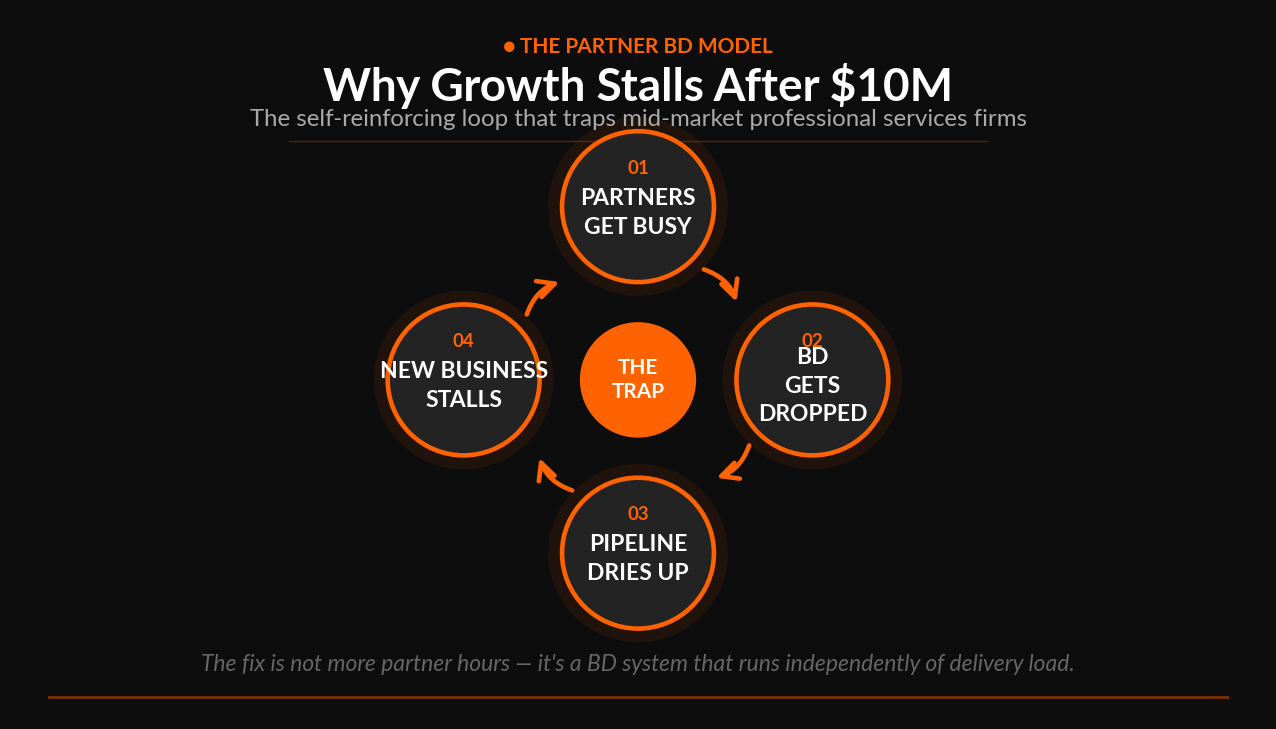
The problem isn't the quality of the work. Partners are excellent, clients are satisfied, and retention is strong. The business development model that got the firm to $10M is the same model they're running at $15M — and it's not designed to scale. It worked when the partners' personal networks were expanding. It breaks when those networks have been fully mined and organic referral growth plateaus.
Most firms at this stage don't recognise the plateau as a structural problem. They see it as a pipeline problem and respond by asking partners to spend more time on BD. Partners try, get pulled back into delivery, and the pipeline dries up again. The cycle repeats.
TL;DR
- Mid-market professional services firms ($10M–$30M) are typically running a founder/partner BD model that worked at $5M but creates a ceiling at $15M
- The "partner as rainmaker" model produces highly variable pipeline: when senior partners are busy, new business stops — and partners are always busy
- At $15M–$20M, the firm needs a systematic BD function independent of senior partner time — but most haven't built one
- The transition requires: separating BD prospecting from senior partner delivery, building a managed pipeline for warm prospects, and creating team-level BD visibility
- Firms that navigate this transition successfully typically accelerate from $15M to $25M+ within 18–24 months — from the same team and same service quality
- The bottleneck is almost never the quality of the service — it's the system that generates qualified conversations
Why Does the "Partner as Rainmaker" Model Hit a Ceiling?
In the early years, the senior partners are the brand. They win business because of their personal reputation, their network, and the credibility they've built in their field. This is how $10M firms get built. The problem: this model doesn't compound. It scales linearly with the number of senior partners (expensive) and degrades whenever delivery load peaks (constant).
At $5M ARR, the firm has 3–4 senior partners and a manageable delivery load. Partners can squeeze BD into their calendar. At $15M, the firm has grown but the BD model hasn't. There are more clients to serve, more projects to manage, and the same number of partner-hours available for new business. Something gives — and it's always BD.
The fix isn't hiring more senior partners. It's building a BD infrastructure that makes efficient use of partner time rather than consuming all of it.
What Does the Professional Services Pipeline Gap Actually Look Like at This Stage?
| BD Activity | Typical State at $15M Firm | What It Should Look Like |
|---|---|---|
| Systematic outbound to new-logo prospects | Rare or absent | Monthly cadence targeting 30–50 prospects |
| Nurture of "not yet" warm prospects | Managed in partner memory; often lost | Automated nurture with monthly touches |
| BD activity during peak delivery | Near zero | Maintained by system regardless of delivery load |
| Formal pipeline tracking | Informal or partner-specific | Shared CRM with stage and last-contact visibility |
| BD accountability / forecasting | Not measured | Monthly pipeline reviews with partner accountability |
| Conversion rate visibility | Unknown | Tracked per partner and per service line |
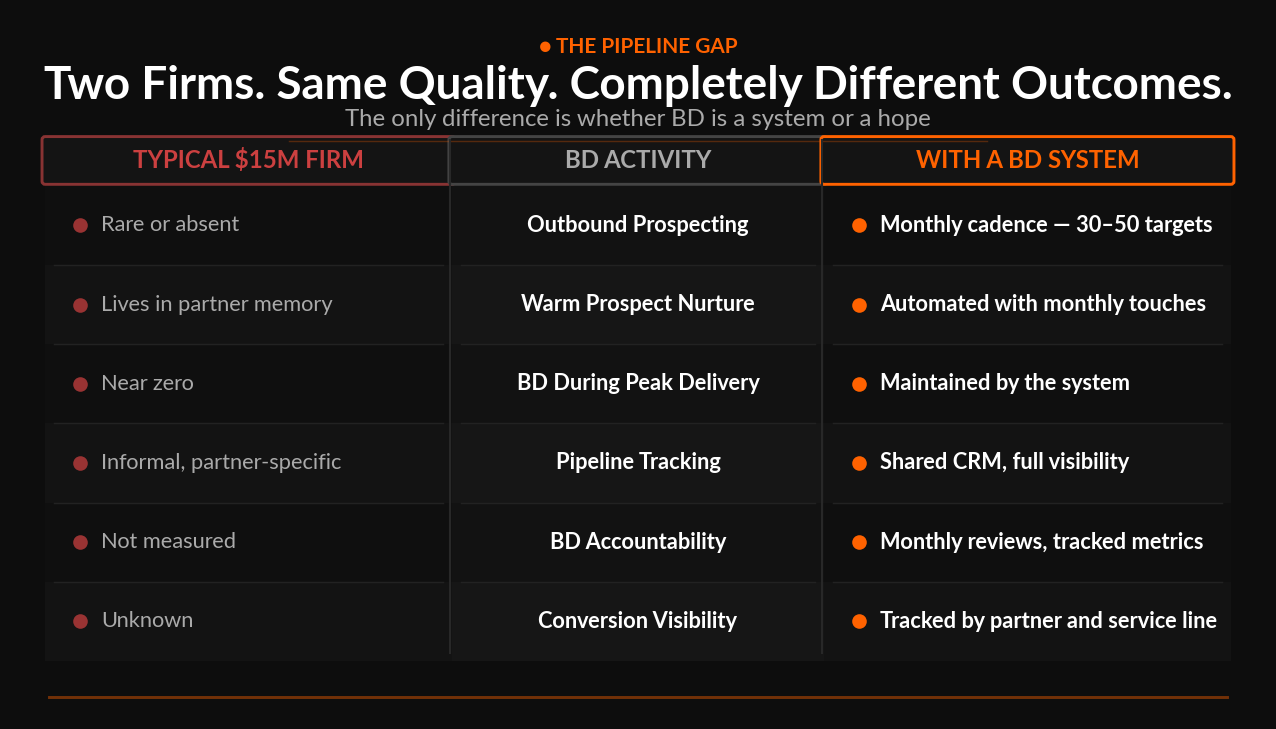
The table above describes two different firms with the same service quality and the same talent. The firm in the right column is growing predictably. The firm in the left column is hoping.
Why Does Organic Referral Growth Plateau?
Referrals are the highest-quality pipeline source for professional services firms. They come with trust, shorter sales cycles, and higher close rates. The problem is that referral volume is bounded by network breadth — and network breadth doesn't compound indefinitely.
A partner's first 5 years of career network generates the majority of their referral pipeline. Years 6–10 see diminishing returns from the same network unless it's actively expanded. By the time a firm is at $15M, most of its referral sources have already referred. The ones who haven't are unlikely to start. New clients in new markets require active outreach — not passive networking.
Firms that recognise this dynamic early build outbound and nurture capabilities before the referral plateau hits. Firms that don't spend years in frustrated confusion about why "doing great work" isn't driving growth.
What Are the Three Changes That Enable the Transition?
Change 1: A dedicated BD coordinator role. Manages pipeline infrastructure — CRM hygiene, follow-up scheduling, nurture sequences, meeting logistics, and partner accountability. Cost: $55,000–$75,000/year. Output: the BD infrastructure runs regardless of what the partners are doing in delivery.
Change 2: A managed nurture system for warm prospects. Every warm prospect enters a managed nurture track with monthly, low-effort touches. The system surfaces re-engagement alerts with full context when a prospect reaches their stated re-engagement date. Partners spend 15 minutes reviewing and personalising — not 2 hours reconstructing from memory.
Change 3: A culture of pipeline visibility. Monthly pipeline reviews where all partners report their warm relationships and conversion rates. When BD is measured and visible, it becomes a shared organisational priority rather than each partner's private project.
Illustrative Example: What This Looks Like in Practice
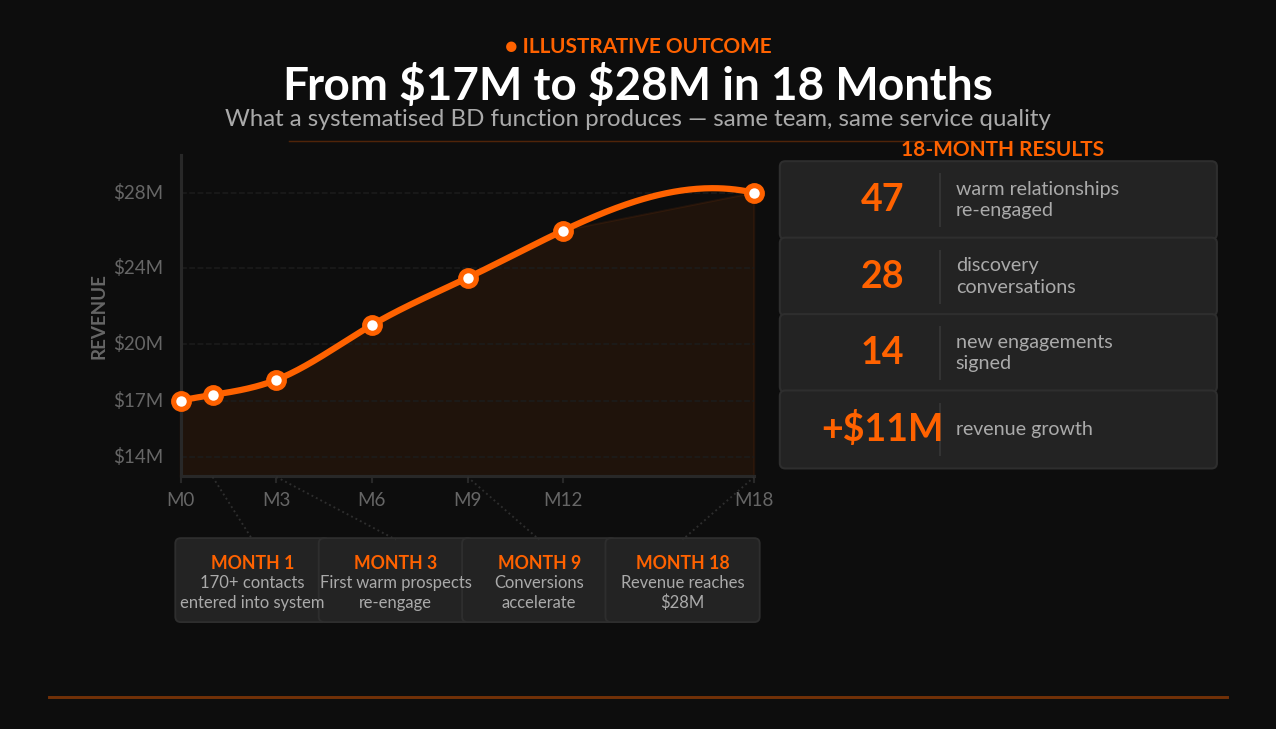
The following scenario is illustrative, based on outcomes observed across AI Xccelerate client engagements. Specific figures are representative, not drawn from a single named client.
A $17M management consulting firm had been between $14M and $18M for 4 years. 8 senior partners, all in delivery. BD was entirely partner-driven and entirely inconsistent.
They hired a BD Coordinator and implemented a structured nurture system for all partner warm relationships. 170+ contacts were entered into the system in month 1.
In 18 months: 47 warm relationships re-engaged, 28 discovery conversations, 14 new engagements signed. Revenue grew from $17M to $28M. The partners' BD time didn't increase — it became more efficient. Instead of spending 3 hours per week trying to remember who to follow up with, each partner spent 45 minutes per week reviewing pre-prepared alerts and attending conversations that were already warm.
For a framework on calculating the ROI of this investment, read How to Calculate ROI on an AI Workforce: The 2026 SMB Framework.
Want to model what your warm pipeline is worth if it was systematically managed? Use the free AI Revenue Team ROI Calculator.
How Does AI Change the BD Infrastructure Equation?
The BD coordinator role and nurture system described above can now be augmented significantly with AI. AI Xccelerate's outbound AI agent Jules handles the prospecting and sequencing work that a BD coordinator would otherwise manage manually — identifying target companies showing buying signals, building personalised outreach sequences, and executing follow-up reliably. The coordinator's role shifts from execution to oversight: reviewing AI-generated output, personalising for specific partner relationships, and managing the exceptions.
The practical result for a $15M professional services firm: outbound prospecting volume increases 3–5x without increasing the coordinator's workload, because the AI handles the high-volume execution and the human handles the high-value judgment.
FAQ
Why do professional services firms plateau at $10M–$20M? Because the BD model that built the firm — personal partner relationships and referrals — doesn't scale beyond a certain point. Referral volume is bounded by network breadth, which plateaus. Growth beyond the plateau requires a systematic BD function that generates new conversations beyond the existing network.
What is the "partner as rainmaker" problem? The structural dependence on senior partners to generate all new business. This model produces unpredictable pipeline because it's contingent on partners having spare time — which is correlated inversely with how well the business is doing. Busy firms have the worst BD momentum.
How do professional services firms build a BD culture? Through measurement and visibility. Monthly pipeline reviews with partner-level accountability. When BD is measured and visible, it becomes a shared organisational priority. When it's invisible, it competes with everything and loses to the most urgent thing in the room.
What is the minimum viable BD infrastructure for a $10M professional services firm? A part-time BD coordinator ($55,000–$75,000/year), a functional CRM that the whole team actually uses, a defined follow-up protocol for warm prospects, and a monthly pipeline review meeting. This infrastructure costs under $100,000/year and is the difference between growing and plateauing.
How do I prevent warm prospect relationships from being lost when a partner leaves? By maintaining them in the CRM, not in the partner's memory. Every warm relationship should have documented last contact, conversation context, next follow-up date, and relationship status. Relationships that live only in a partner's head disappear when that partner departs or goes on holiday.
How long does it take to build a functional BD system at a professional services firm? The infrastructure can be in place within 60 days. First measurable results — warm prospects re-engaging, discovery calls from systematised outreach — typically appear in months 2–3. The compounding effect of a well-maintained nurture system becomes visible at months 6–9 as relationships that have been warming for several months start converting.
Ready to build the BD system that takes your firm to the next level? Book a 20-minute AI Workforce Audit